Written by Paul J Bucknell on February, 13, 2026
1 Peter 5:11 The Glory and Dominion: Tracing the Doxology Through the Manuscripts
“To Him be dominion forever and ever. Amen.” (1 Pet 5:11 NASB)
“To Him be glory and dominion for ever and ever. Amen.”(1 Pet 5:11 KJV)
1 Peter 5:11 is a remarkable passage exalting our God and Savior, but a question arises when comparing with different English Bible versions and other translations.
Most readers will miss this variation. I would have, too, except I came across the verse in a Greek text with two Greek words, “glory and dominion,” not just one, dominion. So why does 1 Peter 5:11 (NASB) say only “dominion” when two Greek words are used, as we can see in the King James translation?
More briefly, why do some versions, like the NASB above, use only one descriptive word for God’s glory while others use two?
The answer lies in the field known as Lower Criticism. Higher Criticism examines authorship, whereas Lower Criticism assesses which translations are considered most accurate. The former questions the authority of God’s Word, while the latter respects it. They examine the Bible’s textual history as reflected in the texts or manuscripts that use it. The text in question was clearly accepted by some authority.
The Original Text
Let me observe 1 Peter 5:11, where this is evident. We examine the Greek text because the New Testament was originally written in Greek; however, there are times of conflict, as in this case. As we discuss this, don’t let the opposing sides create doubt. Our confidence in the text can grow as we openly discuss and review variants that differ only slightly in meaning. In 1 Peter 5:11, we will examine whether the text uses the word 'might' alone or incorporates two words, as shown in other versions.
One word
αὐτῷ τὸ κράτος εἰς τοὺς αἰῶνας τῶν αἰώνων· ἀμήν.
(SBL Greek NT).
To him be the might forever and ever. Amen.
Two words (extra in blue)
αυτω η δοξα και το κρατος εις τους αιωνας των αιωνων αμην. (1550 Stephanus New Testament)
To him be glory and might forever and ever. Amen.
There is some disagreement about which key factor to use in decision-making.
- Which was written earliest? This assumes the earliest manuscript is the most accurate. (Western texts)
- Which has the most reliable manuscripts? This assumes the majority (the Byzantine texts) are the most reliable.
Other factors, such as early translations and the reliability of known manuscript owners, also come into play, but these discussions can be expanded. We will avoid them because, in many cases, they become more subjective.
An Examination
In this case, both renderings use the term for power (kratos), translated as power, strength, might, dominion, sovereignty, and ruling authority.
- The first rendering without glory speaks about how God’s ruling power is manifested forever. The word for strength (kratos) is unlike physical strength (ἰσχύς). It is more of an older English ‘might,’ linked to one’s manifested strength or dominion.
- The second word, glory, placed before might, expresses the radiating glory associated with His rule.
Determining a Conclusion
Together, the words speak more descriptively of the way His mighty strength manifests itself: with His ruling dominion and His recognized glory. This sense of His esteemed power appears elsewhere.
The text's authenticity is not questioned, as the actual text appears in Revelation 5:13.
“And every created thing which is in heaven and on the earth and under the earth and on the sea, and all things in them, I heard saying, “To Him who sits on the throne, and to the Lamb, be blessing and honor and glory and dominion forever and ever.”” (Revelation 5:13 NASB)
“η δοξα και το κρατος εις τους αιωνας των αιωνων”
And because the Greek in 1 Peter 5:11 is an exact quote of Revelation 5:13, we can first affirm its reliability. (Or perhaps John quoted Peter!) Some suggest that Peter offered only an abbreviated declaration of the Lamb's, Jesus Christ’s, full glory. Some would suggest the scribe copying the manuscript might accidentally add the word, perhaps familiar with the Book of Revelation. And so, some suggest that the longer reading is Peter’s original wording. Others argue that the shorter is usually more accurate, whereas others consider other factors. The Western text tends to affirm its own tradition, whereas the Byzantine New Testament supports the longer, more descriptive readings.
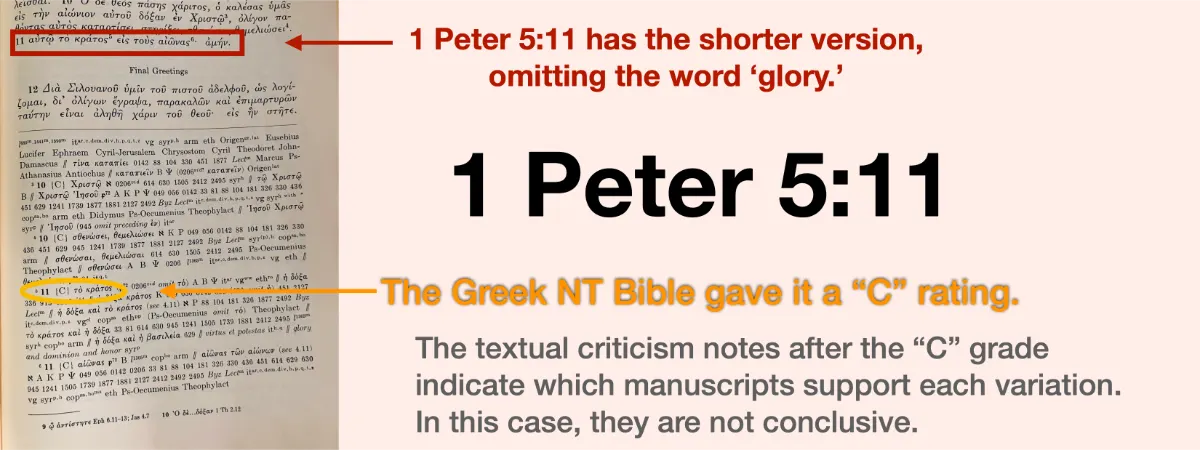
In this case, the Western Greek Bible (United Bible Society) uses the shorter version, as seen above. Its critical note gives it a “C” grade, indicating an inability to decide one way or the other. This is likely due to two reasons: 1 Peter 4:11 already employs the longer version, and Codex Sinaiticus (א/01), a Western text, supports it, making the Western grouping non-uniform. But we add this observation: If they are uncertain, then why do most Bible versions seem to prefer that one word? (See a larger pdf version.)
Summary
The most important point of this verse is not to get caught up in the text but to focus on its meaning and the awe-inspiring way it describes Christ’s full glory. The two variations are of little importance given their shared meaning and usage elsewhere. The meaning is true, and Peter would not want us to get hung up on whether we use one or two words, but to magnify the full glory of Jesus Christ from our hearts.

1 Peter 5:11, Manuscripts, and Study Questions
- What is the textual difference between the two readings of 1 Peter 5:11?
- Does it matter?
- How does Lower Criticism differ from Higher Criticism? Why is Lower Criticism important for understanding Scripture?
- What does the Greek word kratos communicate about Christ’s authority and dominion?
- How does Revelation 5:13 help support the longer reading (“glory and dominion”)?
- How does the author conclude that worshiping Christ is more important than debating minor manuscript differences?Other Articles on Manuscript Studies by Paul J. Bucknell
Is Acts 8:37 in the Bible? A Brief Study on Greek Manuscripts
Most Greek manuscripts omit Acts 8:37. In this case, the critical text of the United Bible Society agrees with the Majority Text (the Byzantine text).
2 Peter 1:17 Greek Textual Analysis | Biblical Foundations for Freedom
. There are no misspellings in this verse, but sometimes there are. However, do remember that the original manuscripts were written in Majuscule ...
The Book of Life with Study Questions - BFFbible.org
Greek manuscript (TR) uses the “book of life.” Almost all Greek manuscripts use “the tree of life” as in 22:14, not “the book of life.” When ...
Jeremiah 17:9 Translations and Interpretations: The Septuagint ...
A Brief Study on Greek Manuscripts ... The KJV largely followed the church tradition noted by the Latin translation (i.e., Vulgate) ...
Where was Christ Jesus crucified—at Golgotha or Calvary?
Greek letters here. All the other English translations for ... Latin Vulgate's wrong translation “book of life.” The many Greek manuscripts ...
The Translation of God's Name, LORD, Yahweh / Jehovah
Greek manuscripts, thanks to Erasmus. Tyndale overlooked the errors in the Old Latin version and went directly to the original sources ...
A Conspiracy Against the Word of God? KJV Versus NIV?
... Greek manuscripts do not have them. They believe they were probably added in later. (3) 1 Timothy 3:16. And without controversy great is the mystery of ...
New Testament | Biblical Foundations for Freedom
... Greek Manuscripts · Is Acts 8:37 in the Bible? A Brief Study on Greek Manuscripts. October, 31, 2019. Questions on the New Testament. Are Denominations Biblical ...