
Written by Paul J Bucknell on September, 15, 2025
2 Peter 1:15-21 The Authority of the Scriptures
The more the Christian believer explores the facts, the stronger and more confident his faith becomes. He need not fear the truth! The righteous person, strengthened through God’s Word, stays steady through the fiercest storms, the darkest nights, and the powerful waves crashing onto the shore. The Holy Spirit, through God’s Word, clears away falsehoods we have collected over the years and sets us free to live the abundant life God desires for us. “But his delight is in the law of the LORD” (Psalm 1:2).
I talked with someone who studied the Bible and other texts. However, studying and believing are worlds apart. Knowing Jesus with all His authority and doubting His resurrection are critical dividing points. Those wanting to deepen their faith must ask:
- What is truth?
- How much do you believe?
- What prevents a deeper faith?
We’ll explore these questions through Peter's story. I first discuss truth and then, (See Heading: 1) The Reliability of the Scripture Accounts), go through 2 Peter 1:15-21, retelling Peter’s testimonial witness.
• What is truth?
The truth isn’t simply what we believe because it’s true; it’s what accurately reflects reality. Many moderns think that multiple, contradictory statements can be correct. For example, they believe that all major religions hold valid truths. This is a confession of disbelief in any of them. The only way someone can believe in many religions simultaneously is by understanding them superficially. Some might argue, for example, that the Hindu god is the same as Allah. But that’s like claiming an orange and an apple are identical because they are fruit. Impossible!
Such thinking is irrational and shows a lack of critical thinking. Similarity doesn’t mean equality. One can believe in the existence of multiple religions—such as Christianity, Judaism, Hinduism, Islam, Zoroastrianism, and Buddhism—but that doesn’t make their claims of truth actual truths. Truth itself is exclusive because anything that contradicts it exposes its falseness, making it untrue.
Christianity is not apologetic about being a proponent of the truth. God calls on every believer and unbeliever to listen, follow, understand, and be transformed. However, some have allowed other interests such as money, wealth, fame, or lust to distract them from their pursuit of truth (Jude 4).
What if God is real? What if Jesus Christ did rise from the dead? What if there is a heaven and hell? Can we know for sure? You might wonder, what is the truth? Jesus Christ, unlike all other great teachers, never claimed to seek the truth. He openly said, “I am the way, and the truth, and the life; no one comes to the Father, but through Me” (John 14:6).
How can we find evidence for Christianity’s truth? Others have tested it and become convinced. Jesus Christ affirms it. Millions of Christians today proclaim God’s faithfulness. He has proven Himself faithful as we stay committed to Him.
• To what degree do you believe?
How do I know the scriptures are accurate? How can I truly trust them? Our faith relies on the trustworthiness of the holy scriptures. I invite you to join me in this article to examine the credibility of the Bible. The more you explore the origins of the Bible, the more you will be amazed by its accuracy, dependability, and power to reveal truth. I can affirm that the copying process was reliable; today, digital printing provides precise replication methods.
Keep in mind a few points as we explore these thoughts from 2 Peter 1:15-21.
1) Be aware of any materialistic bias that dismisses the spiritual world. An honest inquiry must be open to all facts. For example, it is unreasonable to assume that miracles never happened, as you cannot verify that.
2) Second, remember this is not a science lab. We are not questioning credibility, honesty, or consistency, nor are we doubting accurate witnesses.
3) Lastly, I am not referring to irrational viewpoints, but to logical, consistent statements claiming to be accurate revelations of reality.
• What holds you back from believing more deeply?
After Peter saw Jesus die, overwhelmed with disappointment, he returned to his life of fishing. He lost hope in his dreams about Jesus Christ. He died; he was no longer present. Everything changed when he saw the resurrected Jesus Christ. He went on to become an apostle and pastor in Jerusalem for many years. Later, he would die for his faith.
In 2 Peter 1:15-21, Peter shares what he believes about Christ and the scriptures. We should take this seriously. His unique account combines his experiences with Christ both before and after His death. Notice that Peter trusts in the scripture and encourages us to trust it as well. He presents the truth so we will not fall for lies and to help others confirm their faith after he, an eyewitness, would no longer be with us (2 Pet 1:15). He was a dedicated pastor who cared for his flock and protected them from many lies trying to undermine the accuracy of our faith in the holy scriptures.
Let’s study three ways Peter, the eyewitness of Jesus’ death and resurrection, strengthened the believers’ faith before he left the earth.

1) The Reliability of the Scripture Accounts (2 Peter 1:16)
For we did not follow cleverly devised tales when we made known to you the power and coming of our Lord Jesus Christ, but we were eyewitnesses of His majesty. (2 Peter 1:16)
The Scriptures provide a trustworthy account of what happened. Not all of what Peter said became Scripture; in fact, very little of his words did. However, this account, part of 2 Peter, was and remains reliable. If it was accurate then, it remains accurate now, as long as there was no corruption in passing down the text. Peter states that he was not inventing this story and did not participate in “cleverly devised tales.” Examples of such tales include those found in Gnostic writings like the Gospel of Thomas or the Apocalypse of Peter. The church has never recognized these books as God’s Holy Word.
Peter declared the power and coming of our Lord Jesus Christ: “We made known to you the power and coming of our Lord Jesus Christ.” He stated that he would only speak the truth and could testify to Jesus Christ’s miracles, such as healing the blind and walking on water. The letters of 1 and 2 Peter consistently present accounts of Jesus’ life and teaching. Peter’s boldness undoubtedly came from the same power that brought about Jesus Christ’s bodily resurrection (Acts 4:13). Peter was Jesus’ companion day and night. If Peter didn’t believe in the miracles, would he teach them? Wouldn’t he be a doubter or skeptic, or just a fisherman? Would he rise to become a major leader of what we call the church? I think not.
Peter was an eyewitness to what we hear. “We were eyewitnesses of His majesty.” When we doubt the gospel accounts of Jesus Christ in favor of completely unsubstantiated stories, we are relying on the imaginations of people who lived thousands of years after the events. Peter said, “We did not follow cleverly devised tales.” Why not rather trust a reliable witness who actually saw these things happen? Christianity is woven into history, a record of what actually did happen. It takes more faith to believe the stories of those who never saw Jesus than to believe those who saw Him with their own eyes. Peter, a faithful witness, died for Jesus and that faith. “We made known to you the power and coming of our Lord Jesus Christ.”
2) The Supernatural Confirmation of Christ’s Glory (2 Peter 1:17-18)
“For when He received honor and glory from God the Father, such an utterance as this was made to Him by the Majestic Glory, ‘This is My beloved Son with whom I am well-pleased— 18 and we ourselves heard this utterance made from heaven when we were with Him on the holy mountain.’" (2 Pet 1:17-18).
The scriptures are true because of the supernatural confirmation of Christ’s glory. Peter heard with his own ears an utterance made by the Majestic Glory.
“While he was still speaking, a bright cloud overshadowed them, and behold, a voice out of the cloud said, “This is My beloved Son, with whom I am well-pleased; listen to Him!” (Mat 17:5).
Today, we can fake sight and sound, but before electricity, satellites, amplifiers, and laser beams, we must accept that Peter experienced some strange sounds and visions from heaven, meaning from God. Also, notice that this heavenly experience was shared, just like Paul’s confrontation with Christ on the Damascus Road was shared. It was not just Peter’s dream. It happened to Peter, James, and John. Peter mentioned it here to confirm the accuracy of the Gospel account (Luke 9:28-35).
Either it happened or it didn't. Several witnesses confirm the truth, and it is also recorded in three separate, fully consistent written Gospel accounts. If you’re curious about these men’s character, like Peter, look at him on the night Jesus died. He wasn’t perfect, but when he denied knowing Jesus to save his own life, his heart was deeply troubled. “He wept bitterly” (Luke 22:62). After encountering the risen Jesus Christ, Peter risked his life to testify about Jesus. Tradition says he was crucified upside down because of his faith. Do you notice how many written documents from that time all testify to the same event, each one consistent with the others? It’s hard not to accept the consistency of these accounts. And if it’s true, we need to ask ourselves: how do you respond to the Son of God, Jesus the risen Lord?
3) The Prophetic Word (2 Pet 1:19-21,15)
“And so we have the prophetic word made more sure, to which you do well to pay attention as to a lamp shining in a dark place, until the day dawns and the morning star arises in your hearts. But know this first of all, that no prophecy of Scripture is a matter of one's own interpretation, for no prophecy was ever made by an act of human will, but men moved by the Holy Spirit spoke from God” (2 Peter 1:19-21).
“And I will also be diligent that at any time after my departure you will be able to call these things to mind” (2 Peter 1:15).
Lastly, I want to share with you why we can trust the scriptures. The scriptures are a prophetic word from God. God oversaw His revelation and the many ways He revealed it to His prophets. In the old days, reporters sent their news clips to the Reuters service, which then distributed them worldwide. These news clips, written or video edits, can be very helpful if they accurately depict what happened, helping those far away to know God. Sometimes they don’t accurately pass the message on because bias becomes more important than accurate reporting.
In the scriptures, we have what are called prophets. “We have the prophetic word made more sure.” These prophets are not primarily known for predicting the future but for speaking God’s message to His people. There is a whole series of Old Testament books known as the prophetical books. These prophets conveyed what they saw or heard from God. “No prophecy of Scripture is a matter of one’s own interpretation, for no prophecy was ever made by an act of human will, but men moved by the Holy Spirit spoke from God.” Sometimes the revelation came in a dream or vision. When they did speak about future events, it was partly to confirm the accuracy of the message. Jeremiah 28:15-17 provides an example of Jeremiah, a prophet of God, who challenged a false prophet and confirmed it with a short-term prophecy.
“Then Jeremiah the prophet said to Hananiah the prophet, "Listen now, Hananiah, the LORD has not sent you, and you have made this people trust in a lie. Therefore thus says the LORD, 'Behold, I am about to remove you from the face of the earth. This year you are going to die, because you have counseled rebellion against the LORD. So Hananiah the prophet died in the same year in the seventh month.”
They needed to show a brief display of power to confirm the accuracy of Jeremiah’s words. However, for the establishment and truth of God’s words, long-term, repetitive, and highly detailed prophecies are given at different times and by different people. This explains why there are so many scriptures discussing the Messiah and how He would be born and die. They were perfectly accurate, even with a prediction made 400 to 1,000 years earlier. Ezekiel 33:33 states, “So when it comes to pass--as surely it will--then they will know that a prophet has been in their midst.”
The prophet was God’s spokesperson. There were false prophets, and so we see conflicts between false and genuine prophets (1 John 4:1). Many signs confirmed the accuracy of Yahweh’s prophets (see the Gospel of Matthew!). The fulfillment of their predictions proved they were in contact with God Himself. God was affirming His prophets and, so to speak, endorsing His name through their words.
Peter emphasizes two facts in 2 Peter 1:20-21.
1) Verse 21 states that the words of scripture are given by God through men guided by the Holy Spirit. This shows that God oversaw the process of writing the scriptures. We can clearly see man’s personal influence in them. For example, we learn about Peter’s character when reading this letter. You might think that the people involved were new to this process, but that’s not the case. The Old Testament was written in this way as well. The prophecies were given to confirm the authority of the message.
2) Second, we must remember that “no prophecy of Scripture is a matter of one's own interpretation” (2 Peter 1:20). This means that a person is not simply writing his own ideas about God or what God wants. This is what religions do. Men searching for meaning in life share their attempts to interpret the world— their interpretations. This is not the case with the Bible. Peter wrote this letter, but the message was from God. Our books and magazines are filled with man’s guesses about life, but this is not a guess—this is the revelation of God.
Think back to the time when this was written, probably around 66-68 A.D. Peter was very well known and trusted in the church. He sensed he was about to die. So, God moved this well-trusted apostle, appointed by God, to write this letter. In the first chapter, he talks about adding moral excellence to one’s faith. Do you think this man was lying? No. Peter was strict in demanding righteous living. He was also convinced that our faith needed strengthening because he was about to “lay aside his earthly dwelling” (1:14).
I have discussed the person Peter. They didn’t have an issue with him, and we shouldn’t either. But people wonder if someone altered Peter’s letter or Gospel after he wrote it?
The Reliability of Preserving the Scripture
The process of canonizing the New Testament began early in the first-century church with the public reading of apostolic writings (1 Tim 4:13; Col 4:16; Rev 1:3). As a result, New Testament books started circulating soon after they were written. Evidence shows that this collection was developing early on (2 Pet 3:15-16). Before the end of the first century, all 27 New Testament books had been written and accepted by the churches. The canon was complete, and Christians recognized these books. About 200 years after the first century, nearly every verse of the New Testament was cited in one or more of over 36,000 citations by the Church Fathers. However, it took longer for some distant regions to accept these texts. The process was slowed down by limited communication and the abundance of heretical writings, which greatly hindered progress.
The scriptures were usually written for a specific area or city where a church already existed. 1 Peter 1:1, for example, shows where the letter was originally meant to be sent. It is believed that 2 Peter was sent to the same group. These churches likely received and probably copied the letter before passing along the original. However, due to difficult travel and communication, it took a long time for churches in other regions to get a copy or to confirm it was truly written by Peter. The original recipients did not face this issue.
As time went on, copies were distributed to the main centers where Christians lived. In each of these three or four regions, a collection of scriptures was gathered and organized. Many believe that having only one version would ensure greater accuracy. At first glance, this seems true, but it is not. The reliability of the scriptures for later readers comes from the fact that many copies of the same text were circulated, from one region to another, and then copied again. This is what we call a family of texts. Once a copy reached a certain region, it was usually copied from the original version that region received. At that time, there were three main regions with numerous texts or copies, allowing us to compare them and identify differences, as well as pinpoint where the texts might vary.
Textual Criticism
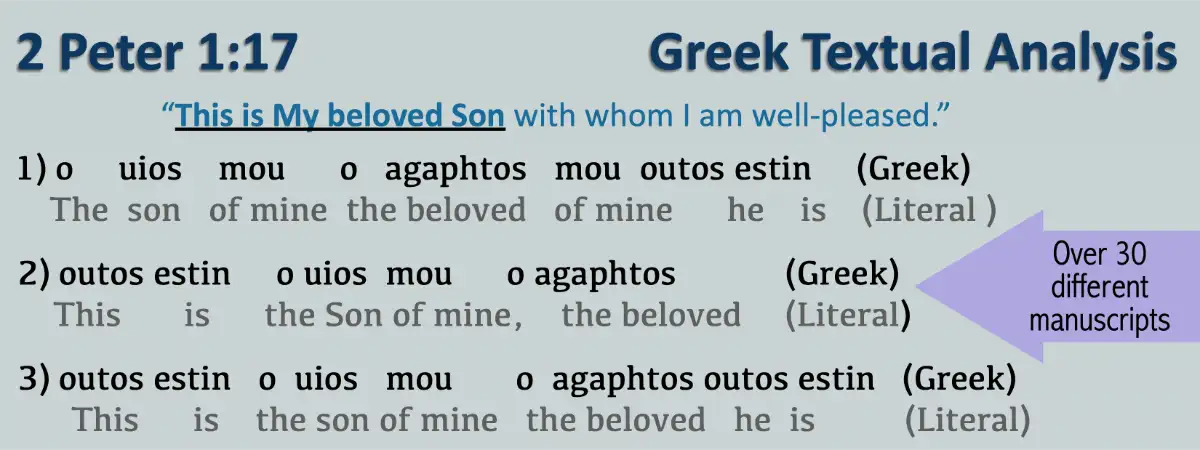
The general epistles, like other New Testament books, had copies from three main regions: Alexandrian (Egyptian), Western (Rome), and Byzantine (Syrian-Byzantium). Let me give you an example of a variation, or mistake, in the passage we just read. Actually, it’s not so much a mistake as it is a lack of knowledge about which reading is correct. We have many texts, and after comparing and evaluating, an educated guess is made. But at no point does an essential teaching change. Most differences are just spelling variations. Verses 15-21 have two variations, one in verse 17 and one in verse 21. Refer to my textual article on the Greek verse 17, which relates to the quote from the gospels that Peter refers to.
This is a variation. However, the meaning remains the same even though the Greek wording is slightly different. Maybe the difference came from a copyist unintentionally rephrasing it in his own style. Only one version, of course, is correct. By the time it is translated for us, the difference is so minor that we usually have no trouble accepting just one form. There are many, many texts to verify their overall reliability.
Conclusion
The scriptures are trustworthy and accurately reveal the truth about God, who created us and the world He made. We can believe in them and trust them. Paul believed in them. Peter told us to trust them instead of other stories and human-made interpretations. My question is, “What prevents you from believing more deeply?” We need to put aside our many doubts and focus on the core issues. If we miss out on the truth, we have nothing else to rely on. On the other hand, with God’s truth and His wonderful grace through Jesus Christ, we have everything to hope for and live by. Our faith is strengthened by growing in confidence in the truth of God.
Takeaway from 2 Peter 1:15-21
• The gospel is based on eyewitness testimony, not myths (2 Pet 1:16).
• Peter heard God’s voice declaring Jesus as His Son at the transfiguration (1:17–18).
• Prophecy is God’s revelation, not human imagination (1:20–21).
• Scripture is a lamp shining in a dark place, guiding believers until Christ’s return (1:19).
• The preservation of the biblical text through many manuscripts shows its reliability.
2 Peter 1:15-21 Bible Study Questions
- What is truth?
- Why does Peter emphasize that the gospel is not based on 'cleverly devised tales'?
- What did Peter witness at the transfiguration? What did he witness at the cross? Why is it important?
- How does Peter’s eyewitness testimony confirm the truth of the gospel?
- What does Peter mean by calling Scripture 'a lamp shining in a dark place'?
- Why is it significant that prophecy does not come from human interpretation?
- Describe the way the Holy Spirit guides the writers of Scripture?
- What evidence supports the reliability of the Bible’s transmission through history?
- What dangers arise when people treat Scripture as human ideas instead of God’s Word?
- How does 2 Peter 1:15-21 strengthen your confidence in the Bible?