Written by Paul J Bucknell on May, 07, 2026
Exodus 12 The Meaning and Significance of Passover | Examining Passover in Light of Chinese New Year Customs
Chinese New Year is wonderful! It’s like America’s Thanksgiving, Christmas, New Year’s, Easter, and Independence Day all rolled into one. Families come together to enjoy their favorite dishes on Thanksgiving. Children receive gifts from their parents and maybe other older relatives and friends at Christmas. On New Year’s Eve, people celebrate late into the night. Easter is a time when people buy and wear new clothes! It’s even similar to July 4th because of the abundance of firecrackers. When I'm in Taiwan, if I ever miss a traditional American holiday I grew up with, I just wait for the Chinese New Year!
I haven’t been able to find the origins of these Chinese New Year customs, whether they predate or postdate Moses leading the people out of Israel during Passover around 1500 BC. The most important thing to understand is that these Chinese traditions help us better picture Jesus Christ’s work of salvation on the cross.
The God of Heaven uses different cultural traditions to communicate His love more effectively, hoping people will seek His protection. God has used many other examples, inscribed in different cultures, to share His truth.
I will use Chinese New Year customs to gain a broader understanding of the Hebrew New Year celebration, Passover. The Lord wants each of us to come out of danger, enter under His protection through the blood, and enjoy His provisions as a close-knit family forever.
Let’s start by examining some Passover preparations.
A. Preparations for the Passover (Ex 12:1-6, 15)
The Hebrews made many preparations for the Passover celebration. I’ll highlight the ones that interestingly parallel the preparations for the Chinese New Year.
1. Time: Started a New Year (12:1-5)
The first Passover marked the beginning of the Jewish calendar. Passover didn’t start until mid-month, giving them many days to prepare for their new life. That first Passover night signaled the Israelites’ departure from Egypt, ending their long and unfair slavery. They started their new national destiny under the Lord’s guidance.
“Therefore if anyone is in Christ, he is a new creature; the old things passed away; behold, new things have come” (2 Corinthians 5:17).
Although it was not linked to a specific event, the Chinese adopted a lunar calendar early on to keep track of days.
During the middle years of the Shang dynasty (c.1300 BC), the Chinese began using a cyclical system to count days. Around the time of Christ's birth, this system also began to be used to reckon years. - Grolier
2. Foods: Securing the lamb (12:5-6)
Shortly before the Chinese New Year, people flock to the market. Long lines often form, making streets impassable. Similarly, the Hebrews prepare for their special New Year’s food. They select a one-year-old male lamb in good condition, without blemish. The lamb stays with them for four days, and then on New Year’s Eve, they kill it to prepare for cooking and eating. Chinese people always get the best food for Chinese New Year and are willing to spend extra money on special dishes.
3. Cleaning: Cleaned the house ‘Chu Syi’ (12:15)
On the first day of Passover, which is also the first day of the Feast of Unleavened Bread, the Israelites went through their homes thoroughly to clean every part. They visibly looked for any signs of leaven, but the process ended with a complete house cleaning.
In Chinese culture, “Chu syi’ is the last day of the twelfth month. This day is for getting rid of old things and buying something new, similar to a spring cleaning. During the day, the house must be cleaned. ... The most important part of the day is the final meal, when everyone, from students to workers, usually returns home.” This cleaning is called “Sung Jyou” (literally, “get rid of old”). During this period of cleaning, every household must wait until the fifth day of the first month to clean again. The day's highlight is the last meal, which everyone, including students and distant workers, typically returns home to enjoy.
4. Return home (12:4) ‘Buy tickets.’
For the Hebrews, everyone had to return home to celebrate Passover. They must, in remembrance, gather as a family and eat the lamb together. This family reunion is also true for the Chinese. If you ever travel during the Chinese New Year, you will never forget the experience. Not only are there long lines to buy tickets, but traffic is also heavy. Families are eager to invite guests to join them in the New Year’s celebration.
New Testament Significance: Christ Our Passover
In 1 Corinthians 5:7, it says, “For Christ our Passover has been sacrificed.” Let’s take a brief tour through Romans!
- Belief: New life in Christ; everything rotates around Him (12:19-20)
- Justification: Christ through His sacrifice secured our forgiveness if we hide (believe) in Him.
- Sanctification: Eliminate every sin (1 Cor 5:6-8)
- Reunion: Fellowship weekly and for eternity
B. Celebrating the Passover (Exodus 12:7-13)
Following the preparations for New Year’s Day are the critical steps to protect oneself.
1. Spread the Blood on the doorposts and lintel (12:7)
Although they could not fully understand the significance of spreading the lamb’s blood, the Hebrews obeyed Moses. They took the lamb they had just slain and placed its blood into a large bowl. Then they used a hyssop branch as a brush. Dipping the branch into the bowl, they painted the blood on the doorposts and the lintel (the top beam over the doorway). This act resembles making a cross, because as many of you know, it is not really the lamb’s blood that saves, but the Lamb of God, the Savior Jesus Christ. His blood saves and protects.
“How much more will the blood of Christ, who through the eternal Spirit offered Himself without blemish to God, cleanse your conscience from dead works to serve the living God?” (Hebrews 9:14)
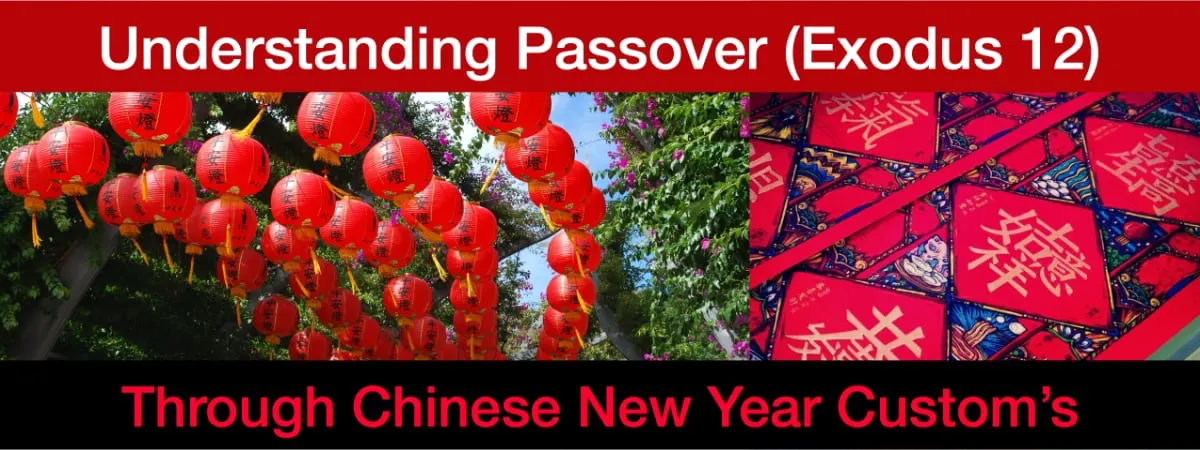
Similarly, during Chinese New Year, the Chinese hang red banners over each home’s entrance. Everyone has them. Before paper was affordable or common, it’s likely that blood was used instead. There are three banners: one across the top of the door and one partway down each side. Today, they often include words printed on the red paper. Chinese Christians frequently write important Bible truths on these door banners. This practice grew from a fear that will be mentioned later.
2. Eat the Food (12:8-11)
It was not enough to just paint the blood on the doorposts and over the top. The Hebrews also had to eat the meal in a specific way. The bread did not contain any yeast; they ate something called matzo, which was like a cracker. They had strict rules to eat all of it, leaving no leftovers. They also had to follow cleanliness rules. It is this act of eating the lamb and observing Passover—when Jesus died—that gives communion deep meaning. It was for our sins that the Lamb of God died. The Chinese have many special dishes for Chinese New Year. The only rule for cooking seemed to be to eat well and celebrate that they had survived the night.
3. The Lord Protects (12:12-13; 22-23)
You might be wondering what they needed protection from. In verses 12-13, we see how God sent an angel of death across Egypt. No one was to go outside; if they did, the blood over the entrance would no longer protect them. The angel of death spread across the city, not respecting people or cattle and killing the firstborn male in each household. However, if he saw the blood on the doorposts, he would pass over that household; no one would die. This is why they call this celebration Passover.
Chinese New Year story: Nyan/gungsyi
The Chinese had a story similar to that of the Hebrews. The Nian (年), which literally means “year,” was known to be a very fierce animal. It typically lived high in the mountains. Toward the end of each year, the Nian, hungry from months of winter, would come down from the mountains to feast on people and animals. Considering all these factors, everyone prepared in advance. On that night, everyone stayed at home and ate the food they had prepared, not daring to go outside lest they be caught unaware by Nian.
The beast disliked red and noise, so the villagers would gather and make red lanterns and paint red on their doorways to scare Nian away.
In earlier times, there were no firecrackers, so people burned sticks of bamboo that popped and cracked to scare Nian.
After the night, they celebrated their survival by saying “Gwo Nian,” which literally means “Nian has passed,” but is now understood in Chinese as “the year has passed,” signifying the start of a new year.
At dawn the next day, everyone came out of their homes to see if their relatives or friends had been eaten. Many greeted each other with “Congratulations! (Gùng syî),” happy to see that everyone was still alive.
The most important point, however, is to recognize that this destructive creature is still around. The Bible tells us that everyone is under the influence of the evil one. How do we know this? Because our sins put our lives under his power. Listen to Hebrews 2:14-15.
“Since then the children share in flesh and blood, He Himself likewise also partook of the same, that through death He might render powerless him who had the power of death, that is, the devil; and might deliver those who through fear of death were subject to slavery all their lives” (Hebrews 2:14-15).

4. Yearly ‘holy day’ (12:16)
“And on the first day you shall have a holy assembly, and another holy assembly on the seventh day; no work at all shall be done on them, except what must be eaten by every person, that alone may be prepared by you.” (Exodus 12:16)
No one was supposed to do any work. I can tell an American not to work, and he will be glad to comply, but tell the Chinese? Impossible! They are simply too industrious; you have to force them to take a break. It is quite amazing, though, to see these hardworking Chinese workers close their shops only during the Chinese New Year’s Spring Festival for several days. Just as the Hebrew New Year led into the Feast of Unleavened Bread, the celebration and family reunion continued for a few days.
Application
Have you realized the danger you’re in? Back in those days, the destroyer was only allowed to take the firstborn males. If such a destroyer came over China or arrived here today, it would wipe out the people. The Lord made a one-time sacrifice to appease the destroyer. In I Corinthians 5:7, it says, “For Christ our Passover has been sacrificed.” Jesus Christ became the slain lamb, and we must believe in Him to find life. We might not see all the ways we have sinned and offended God, but look at how He reached out to us. Judgment hasn’t come sooner because God postponed it. Sickness warns us of how dangerous our condition is—soon we will die. But praise God that He provided a way to pacify the destroyer. All the lambs that were killed couldn’t satisfy God’s anger toward us today, but the blood of His own Son was enough to meet the demands of His great court of justice.
“My little children, I am writing these things to you that you may not sin. And if anyone sins, we have an Advocate with the Father, Jesus Christ the righteous; and He Himself is the propitiation for our sins; and not for ours only, but also for those of the whole world. 3 And by this we know that we have come to know Him, if we keep His commandments.” (1 John 2:1-3, NASB)
C. Provisions for His Family (Exodus 12:1-27)
The escape from death and slavery to Satan is only part of this important story. Some people reason that they will believe in Jesus privately just in case it is true. They think they will keep living their old ways. The Lord established this celebration at the beginning of a new year to mark a new relationship, indeed, a new life! Let’s look at several aspects of this new relationship!
1. New Relationship with Lord - a new beginning - out of slavery
Those familiar with the story of the Exodus understand that the departure from Egypt was also a way to escape Egyptian slavery, beginning with that first night called Passover. They stood up to eat because it symbolized eating quickly before they left. They left that same night—never to come back. They headed for the Promised Land, just as the Lord had promised.
2. New Life with New Year: Passover -> Feast of Unleavened Bread (12:19-20)
The Israelites thoroughly cleaned their homes of leaven, which represented sin (1 Cor 5:6-8). This symbolized eliminating all the old ways and beginning again. Just like when we buy new furniture for a new home, a new calendar, or start a new life free from sin, in a new place, with the Lord. They were also to remove any old loyalties and associations that could weaken their devotion to God.
3. They Treasured the Lord’s Protection (12:16-27)
• Passover marked the beginning of something new. This Passover would become a lasting ceremony celebrated through generations, much like how people observe New Year’s Day every year (12:14). Even in the face of wars and famines, New Year’s Day still gets celebrated. These ceremonies and traditions preserve sweet memories.
• The extension of its impact. The Feast of Unleavened Bread begins as Passover ends. While Passover lasts only one day, the Feast of Unleavened Bread continues for seven more days. I’ve always wondered when the Chinese New Year stops. Chinese New Year lasts several days: the first day, the second, and so on. Something big happened that would change our lives.
• Share with your children (12:24). They must ensure they pass their traditions to their children. Cutting off one generation from these traditions means losing those memories. The traditions are no longer theirs. But because it involves food and activities, it’s very easy to pass them on. They were instructed to tell the meaning behind the customs each year (12:26-27).
Summary
The Lord began something new for His people. He was establishing traditions to remind them of the major events when He freed them from slavery and brought them into His blessed presence. Remembering the past should influence their future. The Passover evoked memories of past deliverance and served as a reminder of how God would deal with them in the future. The Lord wanted His people to understand that just as He delivered them in the past, He would continue to deliver them in the future. He cares and still cares. He loves and will always love. He delivered them and will deliver them so they could be a special people unto Himself. He wanted them to value His care for them, just as He loved them.
Conclusion
Chinese New Year traditions offer valuable insights into how our Creator God interacts not only with the Chinese but with all people. These customs help people worldwide better understand God’s love and saving power. He wants them to know that salvation is urgently needed and not far away.
I am not saying the Chinese celebrated Passover, but the symbolism of Passover can help us better understand salvation. The original Passover foreshadowed the greater, eternal work of Jesus Christ, the Lamb of God, who died on the cross for our sins. While only the oldest son was at risk in the Passover, for both Jews and non-Jews, the danger extends to everyone. All are warned that humanity lives under the threat of death’s judgment.
The ‘Nyan,’ the Destroyer—the Devil—is loose, and his power is clear. The Lord desires to protect us, but we must follow His instructions. Do you think hanging red banners around your door will help? They are only symbolic of what truly protects us: the blood of Christ. He died on the cross two thousand years ago, but we must believe in Him for it to be effective. We need to trust and accept His sacrifice, painting the blood over our lives so the destroyer cannot harm us. Whenever he sees it, he knows God’s wrath has been satisfied. The devil loses his hold on those covered by the blood. So we can say “Gung s'yi” to every believer—they’ve escaped the grasp of evil.
God’s protection is just the beginning; He also wants us to experience His abundant blessings. Many think of blessing as material wealth and say “Fa tsai” (Hope you get rich!), but true riches are found in meaningful relationships. It’s no fun to be wealthy and lonely. We want to build beautiful relationships and share what we have. Real riches are eternal; we cannot take earthly possessions with us. We need to see God’s grace poured out upon us. This is what He offers those who believe. Jesus Christ didn’t just die to take away our sins; He rose again to lead us into a new family in His kingdom. All His followers are part of His royal family. Sins and selfishness are in the past—behold, the new has come.
Have you believed? Now is the time. Do not think salvation is just about escape—no. He has rescued us from death and misery, placing us in His wonderful family of God. I hope each Chinese New Year becomes a time when we truly say “Gung s'yi, Fa tsai,” because it is true. You have escaped God's wrath and the clutches of the evil one; now, enjoy the riches of His kingdom forever.
Study Questions
- Why did God begin Israel’s calendar around the first Passover, and what does this teach about new life?
- What did the lamb without blemish teach Israel about sacrifice and God’s appointed means of protection?
- How does removing leaven from the house illustrate repentance and sanctification?
- Why was family gathering and teaching the children so important in the Passover celebration?
- What does the blood on the doorposts show about faith, obedience, and God’s mercy?
- How can Chinese New Year customs help illustrate Passover themes without claiming the traditions are the same?
- What does 1 Corinthians 5:7 mean when it says, “Christ our Passover has been sacrificed”?