Written by Paul J Bucknell on May, 07, 2026
Exodus 23:14-17 Old Testament Feasts | Confusion On the Three Hebrew Feasts
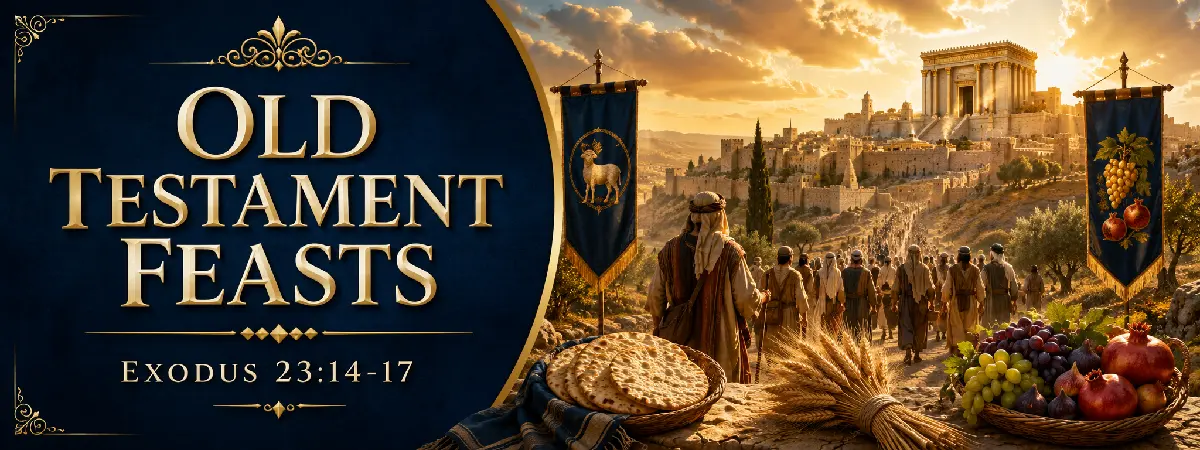
14 Three times a year you shall celebrate a feast to Me. 15 You shall observe the Feast of Unleavened Bread; for seven days you are to eat unleavened bread, as I commanded you, at the appointed time in the month Abib, for in it you came out of Egypt. And none shall appear before Me empty-handed. 16 Also you shall observe the Feast of the Harvest of the first fruits of your labors from what you sow in the field; also the Feast of the Ingathering at the end of the year when you gather in the fruit of your labors from the field. 17 Three times a year all your males shall appear before the Lord God. (Exodus 23:14-17)
Many Christians are confused about how to apply the laws of the Old Testament to ourselves, now that we live under the New Covenant (i.e., Testament). For example, the law requires men to go to Jerusalem three times a year to observe the three different feasts. A Christian group has recently been promoting the idea that Christians should observe these feasts. We respect their focus on the Old Testament, but they miss the point and application of these passages. It’s not possible or appropriate for us to observe such laws. For example, how many of us could realistically travel to Jerusalem three times a year? They could walk and camp, but those living overseas would need to spend a lot of money and time.
Think about what it would mean for my family of ten—we’d almost have to charter a plane! Even if we could physically get to Jerusalem, should we celebrate these feasts as prescribed in the Old Testament? Not anymore. The feasts were foreshadowing something much greater. It’s good to learn about the feasts, and there’s value in understanding how the Jews celebrated them in the Old Testament. However, the purpose of this lesson is not to teach all the details of their seven mandatory celebrations but to highlight their meaning in light of the New Covenant. Let’s explore each of these feasts and see how they relate to our Christian lives today. They are highly relevant!
Introduction to the Three Feasts
The three essential feasts were the Feast of Unleavened Bread, the Feast of the Harvest, and finally, the Feast of the Ingathering. There were additional feasts, but these were mandatory. Every adult man was required to participate. This, in turn, would shape and influence every family and business, not to mention society itself. We will first introduce these important feasts and then examine each of them to understand how they are to be interpreted in light of the Gospel of the Messiah, Jesus Christ.
Feast of Unleavened Bread
The Feast of Unleavened Bread, better known as Passover, was celebrated at the beginning of each year. The Passover merged with another feast of Unleavened Bread. Passover was brief, while the Feast of Unleavened Bread lasted a week. This represents Christ’s death and resurrection on the cross. Today, believers celebrate this through communion as taught by Jesus (1 Cor 11).
Feast of the Harvest
The Feast of the Harvest, also known as Pentecost. It was observed fifty days after Passover. We are all familiar with what happened in Acts 1 and 2. That was the time when the Spirit of God came to empower the church. This is called the ‘down deposit’ of the Holy Spirit that dwells in the lives of God’s people.
Feast of the Ingathering
The Feast of the Ingathering is the final feast of the year. It is not the last day of the year but the last celebration. It marked the time when all the final harvests were to be brought in. This refers to the Second Coming of Christ Jesus. For the Christian church, this prophetic final feast has not yet taken place. Christ’s second coming involves not only the gathering of believers but also the Final Judgment. All of God’s chosen are collected and brought into God’s presence with resurrected bodies.
These three feasts mark the most significant times in the Christian calendar. We frequently reflect on the first two events, which are all completed. However, regarding the third, we look forward to the Second Coming of Christ with excitement and anticipation. To better understand what this means for believers, we need to interpret the Old Testament through the lens of the New Testament. Christ used this approach—telling the men on the way to Emmaus to 'open your Old Testament and look’—after His death. He also instructed His disciples about the kingdom of God before ascending to heaven in Acts 1. Jesus simply showed His disciples how He fulfilled the Old Testament scriptures. (Note the many instances when "written” is used in the Gospels.)
They prepared God’s people for a more glorious revelation of His truth. I believe this still happens today. While we are bound in the flesh on earth, we will enter another stage where we will see things more clearly. Right now, we see things only dimly (1 Cor 13).
We can look back and see that these three feasts find their greater fulfillment in Christ. If their fulfillment is in Christ, then we are not disregarding the significance of these feasts by thinking about how Christ’s work was portrayed in them. We are searching for their prophetic meaning. If we were under the Old Covenant, then we would need to keep the particulars, but we are not. We are under the much better New Covenant. We must not allow the particulars (how to keep the law in specific ways) to disregard Christ (the ultimate purpose of the laws).
There is nothing wrong with keeping the particulars just so one keeps the main purpose in mind: the feasts are about remembering and focusing on Christ’s work. It would be utterly senseless to actually get rid of all the yeast in our homes once a year and forget about being careful to eliminate our sins for which the leaven stood. The problem with Christians regularly trying to keep the feasts is that it takes the emphasis away from Christ and onto keeping the laws. One’s perspective easily becomes tainted as we stare into the particulars. Don’t look at Christ through the Old, but rather look at the Old Covenant through the New.
Once we focus deeply on the Old Testament Laws, we often compare how other Christians observe feast laws as we do. However, this is not the right way to view our brothers and sisters. Instead, we should see them through the lens of the greater fulfillment in Christ and the teachings of the New Testament. We are one family in Christ!
Do you see the difference? Having known Christ, we should live in His freedom. Christ forgave our sins and made us righteous before God. It is unhealthy to judge Christians based on whether they follow specific Old Covenant laws. Instead, as Holy Communion reminds us, we should focus on Christ and His redemptive work in the Gospel. This is the key to growing as healthy disciples of Christ. We encourage Christians to seek to know Christ more, rather than to keep track of whether they obey certain laws. The Christian is not obligated to observe these three Old Covenant feasts because we live under the New Covenant. We have died to the Law’s claim on us (Romans 6:1-7). The Law’s current significance lies mainly in its prediction and depiction of Christ’s work. Now, let’s examine how Christ fulfilled these through each of the three Old Testament festivals and what they mean for our Christian lives today.

The Feast of Unleavened Bread & the Passover
The Feast of the Unleavened Bread, along with Passover, marks the beginning of the Hebrew calendar in the first month of the year—Abiv (or Nissan). These three festivals are actually combined into one seven-day period called the Feast of Unleavened Bread, as mentioned in Exodus 23:14, which includes the Passover, Feast of Unleavened Bread, and the Day of Firstfruits.
The Hebrew calendar plays a crucial role in shaping our Christian life perspective. There are two other times when the Israelites gather in Jerusalem: the Day of Pentecost and the Feast of Tabernacles, both of which also include three holidays packed into one celebration.
Many cultures celebrate the New Year, but is it linked to their origin stories like in Hebrew tradition? God has made it clear that it is His redemptive work on the cross that calls His people into existence. This was true for Israel. We can think of how God called Israel from Egypt through the Exodus. This truth is even more evident for the church today. The foundation of the church remains strong in the work of Christ on the cross.
The Lord combined three festivals into one “Feast of Unleavened Bread” for the Hebrews with purpose. Otherwise, you might suspect we're sneaking the mention of Passover into the Feast of Unleavened Bread.
It is for this specific religious and ceremonial purpose that the High Priest goes into the wheat fields to check the condition of the crop, determining if the wheat is “ABIB”—ripe and ready. If the wheat is not Abib, that is, not ripe and ready, then the first month has not yet arrived.
The Feast of Passover begins at the start of the 14th day of the Hebrew first month, called Nissan (also called Abib), at sundown. The Passover is followed by the 7-day Feast of Unleavened Bread, beginning with the High Holy Day, which is an Annual High Sabbath, on the 15th day at sundown. The 7-day feast continues through the 21st day (also known as: The Week of Unleavened Bread).
During the seven-day Feast of Unleavened Bread, Sunday is a special festival marked by unique religious devotional and sacrificial practices that welcome the annual early spring wheat harvest. On the Sunday after Passover, during the same feast, the Feast of Firstfruits takes place. That particular Sunday, a Hebrew High Priest takes a bundle of freshly harvested, ripe spring wheat and waves it before God as an offering of thanks for the upcoming spring wheat harvest. The wheat must be ripe, not green or immature, so they are not empty-handed (Ex 23:15). The High Priest personally inspects the wheat in the fields to ensure it is ripe, mature (Abib), and ready for harvest. While Easter follows the calendar date, Passover always follows the grain's ripening. From this Sunday, fifty days are counted until the next feast, Pentecost. Therefore, in our calendar, Easter can sometimes occur before or after Passover.
Exodus 23 Bible Study Questions
1. What were the three mandatory feasts named in Exodus 23:14-17, and why did they require Israel’s men to appear before the Lord?
2. Why is it important to understand the Old Testament feasts through the New Covenant rather than turning them into a new Christian legal requirement?
3. How does the Feast of Unleavened Bread, along with Passover and Firstfruits, point to the death and resurrection of Jesus Christ?
4. What connection does this lesson make between the Feast of Harvest and the coming of the Holy Spirit at Pentecost?
5. How does the Feast of Ingathering point forward to Christ’s second coming and the final gathering of God’s people?
6. What spiritual danger arises when Christians focus on the details of feast-keeping more than on Christ’s fulfillment of the feasts?
7. How can studying the Old Testament feasts deepen your worship, Gospel understanding, and hope in Christ today?