Written by Paul J Bucknell on May, 11, 2026
Numbers 9:1-23 The Believer’s New Faith | The Bible Teaching Commentary
Numbers 9 teaches two marks of redeemed life: remembering God’s salvation and following His presence. Through Passover and the cloud, we see the call to worship gratefully, obey carefully, and trust the Lord’s timing on the journey.
We can criticize the Israelites’ behavior in many ways, but we cannot say they started out wrong. We have already discussed their voluntary offerings. Now, we see their beautiful life of obedience once again. We should not grow tired of seeing, hearing, and living in obedience. The Lord delights in this, and our lives thrive on it just as the sun and water give life to plants. Let’s look at two ways the Israelites maintained sensitive obedience to two of the Lord’s commands. Each serves as a clear reminder of two fundamental concepts in our Christian walk.
A. Keeping the Passover & Celebrating Communion (Nu 9: 1-14)
1. The Lord’s Reminder (1)
That first month of the second year after they had left Egypt was a busy month. The Lord had already given them the commands, but they were briefly repeated again to ensure they were followed correctly. We should be thankful for the Lord’s reminders. It reminds me of the gentle prompts from the Holy Spirit and conscience to follow the truth I had previously heard.
Those who deny the historicity of these records must remember that they are also rejecting the very signs of history that this book actually shows. This introduction again emphasizes the time it was written and the time when certain duties would naturally arise. It is also important to note that this book relies heavily on the previous and subsequent books. The Passover is not redefined here. So far, the significance of this book has mainly been documenting the execution of many rules. If this section were written with the goal of boosting the priesthood’s standing among the people, I believe they would succeed in eroding the people’s self-awareness.
2. The Lord’s Directive (2-4)
The Passover was to be observed.
- The time: first month, 14th day, twilight.
- The way: just as the Lord had already clearly indicated. Must have kept records.
3. Some People’s Dilemma (5-8)
The Passover was observed as prescribed in the wilderness of Sinai, following Jehovah's order. The issue wasn't disobedience but confusion. They weren’t trying to avoid the law’s purpose; they were trying to understand its intent in their lives. In this situation, adding another law was necessary to clarify what the Lord wanted.
- Some couldn’t celebrate Passover because of contact with the dead. They needed to understand why they were barred from participating in the offer. They doubted that this was the Lord’s intention. In other words, two commands guide them. One says to offer; the other says do not.
- I appreciate Moses’ willingness to resolve this dilemma. Leaders should be ready to find answers for those who seek what’s best but are uncertain. It’s also good to see Moses go directly to the Lord for guidance. We must be students of God’s Word.
4. The Lord’s Direction (9-14) ….Celebrate New Year’s Late
The Lord respects Moses and the people’s search for truth by responding. God is never too busy. The Lord goes beyond the questions of that individual group and establishes further policies. Unlike in our society, where people look for loopholes, and the government has to create thousands of laws to prevent those trying to bypass the law’s purpose.
- They shall celebrate the Passover but delay it by a month. Passover shouldn’t be missed, but it can be delayed. Some might argue that being near a dead body doesn’t matter, but it does. The Lord didn’t want that. He did want them to participate.
- Otherwise, the rules for the offering are the same. Don’t break a bone; eat all of it.
- Those not on a long journey or who are unclean must follow the normal procedures. This was so important that such a person should be cut off from the people of God. They would need to bear their own sin in that case. Passover was not a trivial event but a serious one. Exceptions do not justify sloppiness.
- The Lord does not want a separate set of rules for the Gentiles living with the Jews. They can participate along with the Jews. Those in the household were saved from the angel of death, so blood was on the doorway. Exceptions don’t mean one can start creating all kinds of different regulations.
The Lord is so good to us for providing the Jews with a chance to remember how God redeemed them from their bondage in Egypt. We must not neglect communion. We cannot ignore our sins if we take the bloodshed on the cross lightly. Everyone must participate in remembering the sacrificial lamb. It is their faith in action. Only by “eating my flesh” can one gain eternal life (Jn 6:54). There is no other way to save someone.

B. Following The Cloud: Living By Faith as a Pilgrim (Nu 9:15-23)
1. The Lord’s Presence (15-17)
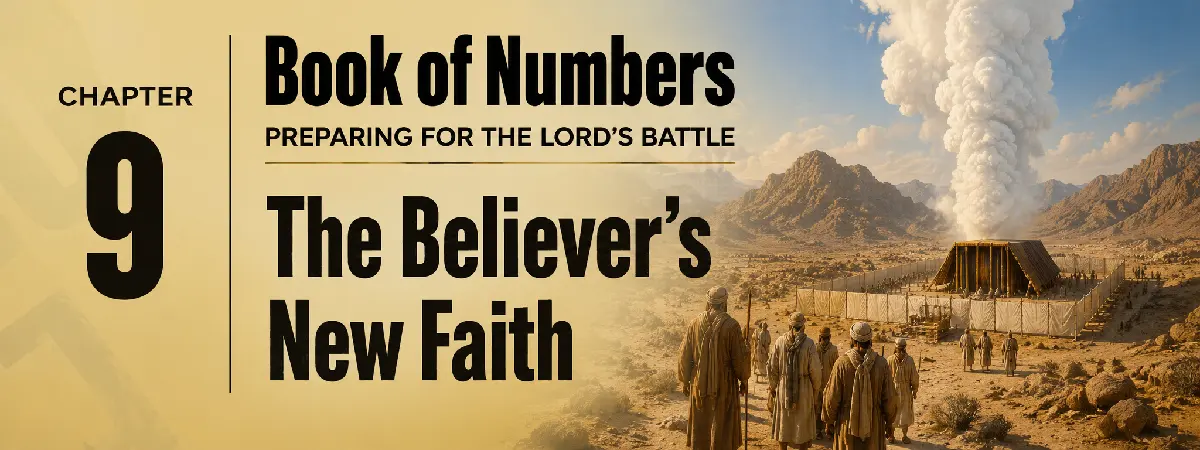
The Lord moved in the cloud from Mt. Sinai when the Tabernacle was fully set up. The cloud covered it during the day, and at night, a fire appeared until morning. This same cloud appeared differently depending on the background. It wasn’t an actual fire, but it looked like fire. We don’t know its size; only that it covered the Tabernacle. This was continuous.
More than anything, it made people aware of God’s presence. God made these people different. His presence was both His mark on them and their protection. They didn’t have to face the hot sun during the day or wild animals at night. Enemies clearly knew that God had marked them.
2. Following the Lord (18-23)
Everyone wishes the Lord would make the hard decisions in our lives, but He hasn’t chosen to do that. The Lord did carefully guide the people through the wilderness. However, when we consider applying this truth to our lives, we see it connected to their redemption rather than family or school decisions. Staying close to the Lord was a test for them. They might have found a place to settle away from Egyptian influence in the southern part of Sinai.
This was a kind of testing: Would they stay aligned with the Lord? Would they enter the promised land? That's why the decision at Kadesh-Barnea was such a national disaster. They refused to follow where the Lord directed them. Wanting to stay near God's people as they walk the path of redemption is good, but one must enter into the promise by faith.
We have only good news about their response to God at this point—notice verse 17. Wherever and whenever the cloud moved, the Israelites would follow and camp. Verse 18 repeats this same truth from the perspective of those who might want to move more often. Even if the cloud didn’t move, they wouldn’t set out, even if it stayed for many days. They felt they wanted to move on, but they decided not to. This is a great advantage of how the tribes were organized around the tabernacle.
The later verses in this section repeat the same message, but they have a purpose. God, through Moses, was emphasizing the importance of obeying every command from the Lord. The movement of the cloud perfectly signified the Lord’s will. Sometimes we might not understand all the details of God’s redemption plan, but we need to pay attention if we want to be saved. Today, many people get caught up in the fine points of redemption, stressing water baptism or baptism of the Holy Spirit. They wrongly assume what the Lord plainly said. Salvation is by faith alone. The Israelites made it a point to move when God moved and to stay still when He stayed still. God’s presence was everything to them, even if it meant waking up at night and wandering around. This spiritual flexibility was essential for their salvation. They had to follow God’s pace and direction to stay in His presence. Otherwise, they were not part of God’s people. Some people want to limit the Lord and decide who He can be. They don’t want to accept all of God’s demands. Like in the parable of the sower, only those who persevere and grow show evidence of God’s grace.
Conclusion to Numbers Chapter 9
Starting our Christian journey correctly is essential because there's always a risk that what we claim to have isn't truly ours. The New Testament provides many warnings about potential failures. The best way to avoid these pitfalls is to start right. Of course, we must remember that both the beginning and the ending of faith are important, but a good start makes a big difference. The two most important truths in this chapter are remembering Christ's work on the cross for our salvation and staying in His presence. No matter what you hear or see, being part of God’s people is the only way we can enter into His promised land. The people were completely committed to God’s way. Let’s regain the spirit we had at the start of our spiritual lives. Let’s hold onto the commitments and pledges we made—they remain, even now, our only hope of entering the Promised Land. Either we follow God’s way with His people, or we don’t enter at all.
Notes
- Those who deny the historicity of these records must remember that they are also rejecting the very signs of history that this book actually shows. This introduction again emphasizes the time it was written and the time when certain duties would naturally arise. It is also important to note that this book relies heavily on the previous one and the subsequent one. The Passover is not redefined here. So far, the significance of this book has mainly been documenting the execution of many rules. If this section was written with the goal of boosting the priesthood’s standing among the people, then I personally believe they would succeed in overcoming the people’s self-awareness. ↩