Written by Paul J Bucknell on November, 09, 2026
Revelation 3:1-6 Sardis: A Serious Call to Self-Examination
Introduction to the Church in Sardis
The spiritual discipline of self-examination awakens us from our complacency, confronts areas of spiritual neglect, and realigns our lives to walk in a manner pleasing to the Lord.
Each Christian and every church faces her enemies. “Be of sober spirit, be on the alert. Your adversary, the devil, prowls around like a roaring lion, seeking someone to devour” (1 Pet 5:8). Our archenemy uses all sorts of devices, but one popular and successful means is to get God’s people off guard. This is what happened at the church, the fifth listed here, at Sardis. The city faced its past shame.
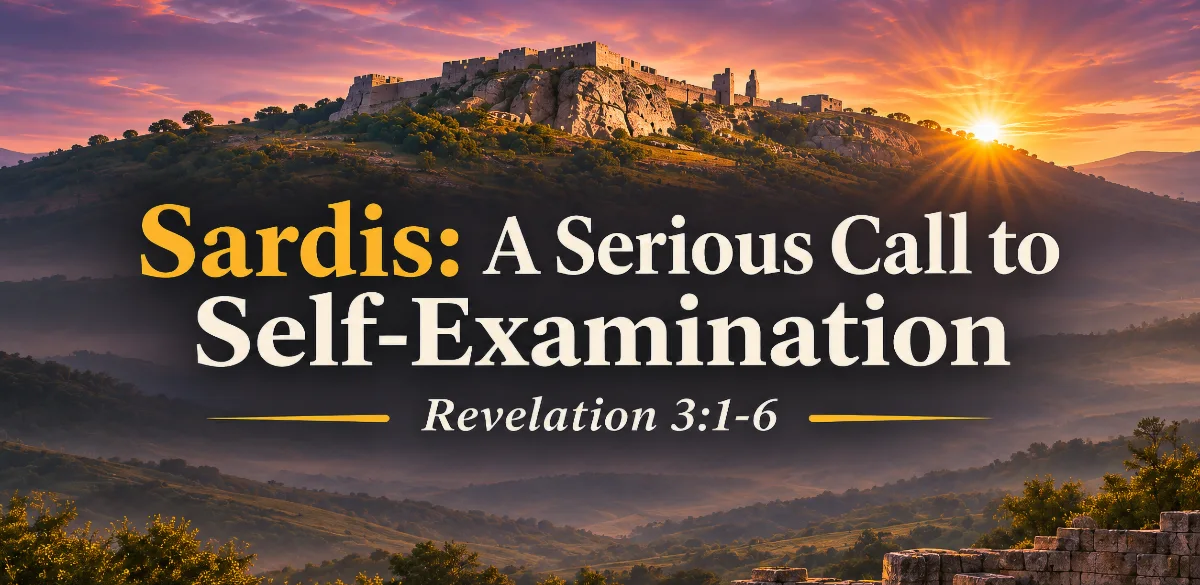
Twice, Sardis, the city perched on a mountain, had fallen asleep and been captured. Their self-confidence originated from being “regarded as the strongest fortified place in the world” (Wiki), which was fine as a layer of protection, but it led to a cloud of self-confidence that lowered their guard. The mount on which Sardis was situated lifted it high above the adjacent valley, with steep cliffs, often described as a citadel.
The Persians happened to conquer the Kingdom of Lydia by taking its capital, Sardis, thanks to a Persian soldier’s careful observation (and Herodotus who recorded this event). He watched a soldier, who evidently knocked his helmet over, descend the steep cliff to retrieve it. This area was not carefully watched at night, as it was assumed no one could ascend that way. But at night he led the Persian troops up that same impossible pathway he had seen the Lydian soldier go back up to his watch. The church sometimes falls into careless situations where we are inattentive. Let’s read the passage, Revelation 3:1-6.
1 He who has the seven Spirits of God and the seven stars says this: ‘I know your deeds, that you have a name that you are alive, but you are dead. 2 Wake up, and strengthen the things that remain, which were about to die; for I have not found your deeds completed in the sight of My God. 3 So remember what you have received and heard; and keep it, and repent. Therefore if you do not wake up, I will come like a thief, and you will not know at what hour I will come to you. 4 But you have a few people in Sardis who have not soiled their garments; and they will walk with Me in white, for they are worthy. 5 He who overcomes will thus be clothed in white garments; and I will not erase his name from the book of life, and I will confess his name before My Father and before His angels. 6 He who has an ear, let him hear what the Spirit says to the churches.’ (Rev 3:1-6, NASB)
They were secure, as we are with the truth of God’s Word and the grace of God, yet their sense of security lulled them into a false sense of safety. This danger can, has, and will again strike God’s people. This is the very reason Jesus confronts them and us.
1. Our Startling Wake-up Call (Rev 3:1-2a)
2. Our Sad Spiritual Lethargy (Rev 3:2b-3)
3. Our Surprising Bright Hope (Rev 3:4-6)
1. Our Startling Wake-up Call (Rev 3:1-2a)
1 To the angel of the church in Sardis write: He who has the seven Spirits of God and the seven stars says this: ‘I know your deeds, that you have a name that you are alive, but you are dead. 2 Wake up, and strengthen the things that remain, which were about to die; for I have not found your deeds completed in the sight of My God.
Have you ever considered how this lack of caution affects the church? We somehow belittle the Word of God’s warning or dismiss the prophet’s words.
But before the warning, the mindset has already taken hold. I can see why. The church has been saved by the precious blood of Jesus Christ. Can anything beat our promised eternal life in Him? He is our Rock, the Lamb, and our Lion. We rightly teach the truth as truth and exhort all to believe it and build their lives upon Christ. There is nothing wrong with this, but it can lead to letting our guard down, treating the most important events as already having happened.
“To the angel of the church in Sardis write: He who has the seven Spirits of God and the seven stars” (3:1)
Verse 1 continues, describing the resurrected and ascended Christ as the one who “has the seven Spirits of God and the seven stars.” It brings back the image of Christ holding the seven churches in his hand, as in Rev 1:20. The number seven represents wholeness, completeness, or totality of all the churches. The seven spirits are not God’s Holy Spirit divided up but are a way of speaking about it, as in the many eyes seen in the OT vision of God. The Spirit of God is everywhere His people dwell. The stars are defined in Revelation 1:20.
“As for the mystery of the seven stars which you saw in My right hand, and the seven golden lampstands: the seven stars are the angels of the seven churches, and the seven lampstands are the seven churches.” (Rev 1:20)
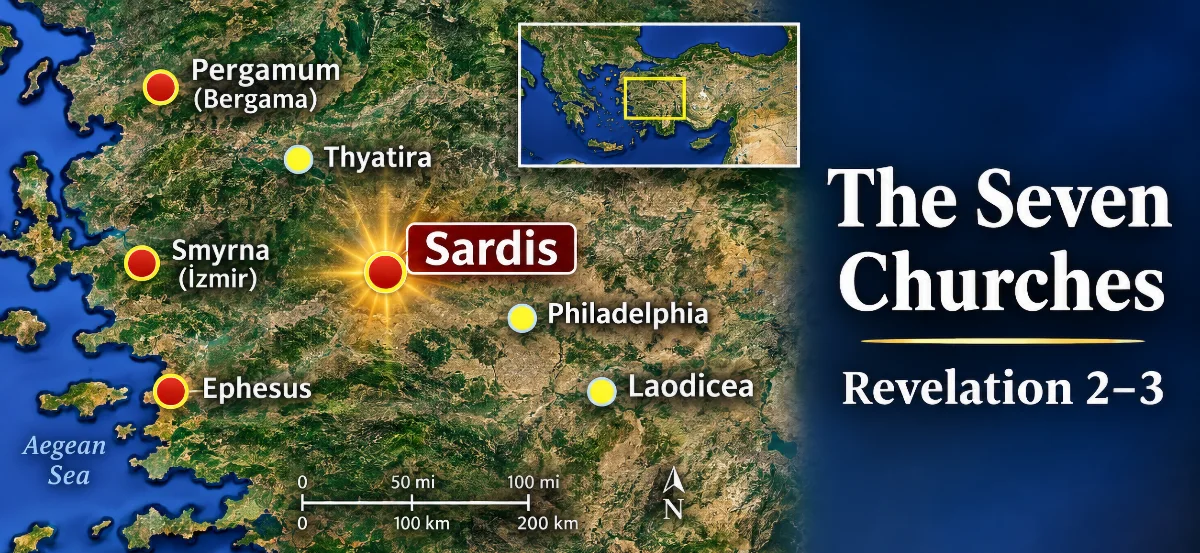
From this description, it is clear that the Lord Jesus holds all the churches accountable to Him. John looked eastward from Patmos, only 60-150 miles across the Aegean Sea. His specific exhortations stem from His authority as the Head of the church. The seven stars identified are His messengers, one for each church. The messenger brings God’s message, the letter, to bear on each church. We can guess whether it refers to an angel overseeing each church or to a church leader. They take the Lord’s message seriously, seeing that “and out of His mouth came a sharp two-edged sword; and His face was like the sun shining in its strength” (Rev 1:16). “In His hand” indicates that the message is from the Lord.
“I know your deeds, that you have a name that you are alive, but you are dead. 2 Wake up, and strengthen the things that remain” (3:1-2a)
The powerful message begins! The Lord boldly describes them as “You are dead,” but before examining this word further, let’s note what else is in this line. Jesus knows all their deeds. ‘Deeds,’ or works, is used 11 times in chapters 2-3, evidently underscoring an essential understanding of how God views His people. Though He might write the message to the messenger, it is clearly for all the people.
Whether in a church or personally, it all starts with a little self-confidence. “Everything is okay.” “It doesn’t matter.” “It’s not that bad.” “Well, it will all work out.” But these responses always lead to undesirable consequences. Jesus seeks to correct our dulled perspective with three descriptions that He first gave to the Christians at Sardis.
God keeps a close eye on our deeds. Our actions, the fruit of our lives, are important to the Lord. As servants, we accomplish things for Him or against Him. We are called to carry out His will. We are not robots, but we must align our actions with what we believe He wants us to do. This is the basis of accountability.
Every judgment is based on the Lord’s expectations and our performance, whether individual, church, or societal. I’ll return to this expectation later and compare it to self-esteem, a replacement viewpoint now popular in our modern age.
At the Great White Throne, when the final judgment comes, we all will appear before the Lord to give an account of our deeds. In time, however, as we see here with the Sardis Christians, we play out our activities. The “I know” means the Lord holds us fully accountable. The secular viewpoint disregards God and any notion of His judgment. Because our society has greatly divorced itself from God, it holds to a different set of standards.
They, and we, often think more about how we view our activities. “You have a name that you are alive” suggests they think highly of themselves. They don’t see any reason for a warning. They are doing all right. Have you ever thought this way? Let me separate two mindsets:
I evaluate my life and activities in light of God’s expectations for me.
I evaluate my life and activities in light of the expectations of my peers, society, and online friends.
Jesus words, “I know your deeds, that you have a name that you are alive, but you are dead” show us that He saw through our superficiality.
Something has drastically changed, but they don’t know it! They think everything is okay and normal. We see this in how they consider themselves alive. They have a name. This is all in the present tense. The tragic and most dangerous observation, though, can’t be seen by them but comes from the Lord: “You are dead.” They feel alive and all right, but the Lord views them as dead.
The difference between the two life perspectives is startling. They could not be more black and white. The church started off well. It is the church of God; they are the redeemed. He still claims them as one in his hand. However, such changes have come upon them undetected; they view themselves as the same.
I wonder if some of you feel spiritually deadish—dull, listless, inattentive, and concluding that God’s Word is irrelevant. In fact, our salvation is as important as ever. Our faith doesn’t rest in our past decision but in our present faith in the living Lord Jesus, who died on the cross and lives for us as Lord of all creation.
After all, the greatest danger is not noticing our diminished sense of protection; otherwise, we would take action. This was the fifth church mentioned in the second and third chapters of Revelation, perhaps seen as the middle of a candelabra, perched high and secure. The greatest help to this kind of believer or church is an admonition to wake up, and this is precisely what Jesus said to them. Our Lord rang the warning bells so they would awaken and rightly assess their true situation.
The Wake-up Calls
Twice, the Lord calls Sardis to wake from a deadly lethargy. What causes us to fall into spiritual lethargy?
“Wake up!” (3:2)
And a warning: “If you do not wake up.” (3:3)
Wake up! Break free from spiritual lethargy and recognize how you have strayed from God.
Though they believe they are doing well, they are, from the Lord’s perspective, spiritually dead: “but you are dead” (3:1). From this spiritual sleep, the Lord seeks to awaken them. What is sleep like? We first know that a person is not fully dead but merely unconscious. They have a life ahead. At some point, they will awaken again and engage with the world.
However, the call to awaken and step out of their spiritual deadness is serious. They could, perhaps, remain inattentive to the Giver of Life and live out their remaining days in a coma. We might wonder what their sin is. There are numerous references to some people in the congregation who are seeking the Lord, but it appears many are dull to spiritual things. Let me first illustrate, then look at the specific hints of waywardness.
I grew up in such a church. It was flourishing in the 1950s, just north of Boston. The pastor wore a black robe; they had paid singers and recited all the right creeds, but they lacked faith. They came, perhaps never thinking anything different, to understand the Bible as tame and Jesus as just a good teacher we should respect. They thought of themselves, much like those in Sardis, as doing well. And the church seemed to thrive by judging itself by Sunday attendance. But their hearts deadened. Their cards were shown when the pastor came to know the Lord at a Billy Graham evangelistic meeting and was kicked out of the pastorate for taking the Gospel seriously. They thought of themselves as good religious people, beyond the stain of any serious sin.
We wonder how God’s perspective can be so different from ours. The Sardis church could not be that far off, could it? This is where the subtle changes happen in the generations of believers. The pattern is noted quite clearly in Judges 2. The church starts in a vibrant response to God’s truth and work in their midst.
This probably happened around 56-57AD during Paul’s third missionary trip through Ephesus.
“9 But when some were becoming hardened and disobedient, speaking evil of the Way before the people, he withdrew from them and took away the disciples, reasoning daily in the school of Tyrannus. 10 This took place for two years, so that all who lived in Asia heard the word of the Lord, both Jews and Greeks.” (Acts 19:9-10)
Scholars differ on whether the Book of Revelation was written before or after Jerusalem’s destruction in 70 AD. If the latter, they suggest John’s exile to Patmos was in the mid-90s. But be sure, all these 7 churches are identified, whether in 20-40 years, and though they had their individual strengths and weaknesses, all are called to be vigilant. Although we can be very attentive to the historical roots of each church, the Lord is much more pointed, stating where they need to grow.
Something happens that causes the church, or at least some in it, to consider their security as an inherent trait of theirs. They profess in the Lord, yet they take Him for granted, loving the church, religion, and community more than the Lord Himself. Some pride themselves on their moral uprightness, while others on their proper doctrine or careful liturgy. But the same pattern occurs.
Self-examination has several components.
Self-examination: Become spiritually attentive and assess your situation in light of God.
The heart willingly opens itself to the Lord’s examination and remains attentive to the Holy Spirit.
One’s mind wrestles with God’s revealing truth, processing it through reflection, prayer, and journaling.
2. Our Sad Spiritual Lethargy (Rev 3:2b-3)
Self-examination: Reflect and repent of ways you have disappointed the Lord.
“2b For, I have not found your deeds completed in the sight of My God. 3 So remember what you have received and heard; and keep it, and repent. Therefore if you do not wake up, I will come like a thief, and you will not know at what hour I will come to you.” (Rev 3:2b-3)
It can be rightly said that one of the church’s greatest enemies is herself. She holds the truth and is protected by it, as found in God’s Word, but due to inattentiveness, she fails to see how the world’s opinion pushes the truth to the side. The message to the messenger, or pastor, to Sardis clearly points out this problem and the need to scrutinize what we genuinely believe. Listen to the Lord’s message.
- “Your deeds”— An account of our works (2b)
In verse 1, Jesus states that He knows their deeds, including ours, but here He speaks about their accountability for those deeds. We should be clear that these deeds are not meant to ensure they have enough good works to enter heaven. We all have missed the mark badly. In Revelation 1, John already clarified Christ’s work for us, namely that He was pierced for us on the cross. Jesus died for us, and only faith in Jesus Christ’s work can we find salvation. However, this wording speaks of the natural and expected outworking of our faith. God knows all these works and keeps us accountable to His expectation. After all, He made us to complete these good works (Eph 2:10).
I assure you that we don’t want to hear “I have not found your deeds completed in the sight of My God,” but if so, let it be now when we can repent, not on the last day when it will be too late to deal with. Now is the age of grace, and we can see in the Lord’s next word, “So remember,” a call to this grace.
- “So remember” — Our chance (3a)
“So remember what you have received and heard; and keep it, and repent.” They had God’s Word; they heard God’s Word; God’s holy word was preached to them, but they placed too much emphasis on their religious attendance. Again, this church took pride in itself, yet it had a serious, cancerous condition that would overtake the whole.
“And He said to them, “You are those who justify yourselves in the sight of men, but God knows your hearts; for that which is highly esteemed among men is detestable in the sight of God.” (Luke 16:15 NASB1995)
There is no concern with self-esteem, a postmodern construct, but with self-examination. Godly living is always associated with examining our souls, carefully considering our thoughts, actions, and expectations for our lives, and repenting where necessary. This process draws us closer to God’s presence as we strip away the superficial and better see who we are in God’s sight.
Our Warning
Wake up, but here is the warning. God is gracious but only to a point. “If you do not wake up, I will come like a thief.” If they hear and ignore the call to change or don’t hear at all, perhaps because they are otherwise entertained, their hope of salvation will disappear. He, like a thief, will come when they least expect it. It will then be too late.
The offered chance comes with a warning that this chance does not last forever. Break free from spiritual lethargy and recognize how you have strayed from God. There are still some good things, such as attending church, giving, or personal Bible study, but one must strengthen what good remains. These good habits are the last to hold on before the final touch of spiritual death snuffs out one’s ability to hear from God. This last phrase highlights a significant point: “I have not found your deeds completed in the sight of My God.”
Self-esteem concerns how I feel about myself, valuing a good feeling above all else, even over what God might say. It’s for this reason the self-esteem movement shuns, ignores, or even belittles God’s Word. In today’s world, we have come to approach our lives this way. But we do not realize how other people’s opinions shape what we esteem about ourselves. As a result, we become manipulated people. Others subtly, or not so subtly, control our decisions. In this way, we lose the fear and consciousness of God Himself.
In contrast, godly living is always associated with self-examination, in which we carefully examine our thoughts, actions, and expectations for our lives, repenting where necessary. This process draws us closer to God’s presence as we strip away the superficial and better see who we are in God’s sight.
Godly living is transparent before God.
We notice our faults and turn from them (repent).
God graciously receives us and works with us.
Self-examination: Let us reflect on and repent of ways we have disappointed the Lord.
3. Our Surprising Bright Hope (Rev 3:4-6)
4 But you have a few people in Sardis who have not soiled their garments; and they will walk with Me in white, for they are worthy. 5 He who overcomes will thus be clothed in white garments; and I will not erase his name from the book of life, and I will confess his name before My Father and before His angels. 6 He who has an ear, let him hear what the Spirit says to the churches.’ (Rev 3:4-6)
God gives hope even to those who are dead. This is extremely gracious. This is not only about Jesus speaking to the physically dead, like Lazarus, and raising him, but also about raising the spiritually deadened or religiously stiff people in a dynamic way, refreshing their focus on the Lord and their spiritual life. This is what Jesus wants for anyone who is drifting.
The most powerful hope is to instill in us a vivid image of what He wants to do in our lives. We might feel guilty for having fallen dead, becoming listless and unresponsive, but we have hope. The Lord has work cut out for you. There is time, since you are now awakened. We can be like the faithful few who have held fast to their spiritual vitality in Christ. These examples give us much insight into the Lord’s expectations, delights, and ways to resolve our problems. Ultimately, we are not discouraged, for the Lord gives each church action steps to become filled with His power.
The faithful “few people” feared God despite the evident spiritual decline in others. We can become very discouraged in our circumstances when people’s hearts grow cold, perhaps because of immorality or a church split, which is always associated with much backbiting. But there are some who have persevered. He notices what you have done, resisting the trend of others leading downward.
“Soiled their garments” refers to ungodly living. The second-largest temple dedicated to Artemis (also Diana) was in Sardis, but we are not told how they fell into a spiritual stupor.
some haveSome have clean garments. This means they have not likewise fallen into that form of ungodly living. Again, God recognizes this. Even more, listen to how the Lord praises them.
“They will walk with Me”
“For they are worthy”
“He who overcomes will thus be clothed in white garments”
“Not erase his name from the book of life”
“I will confess his name before My Father and before His angels.”
This praise report comes from God, who wants His people to do well. By reading the five items, you can sense the Lord’s desire for us all to succeed. First, don’t be deluded into thinking it doesn’t matter. Your life counts, and by His grace, that can change right now, if necessary. These pep talks speak of intimacy with God, even when rejected by the majority. He applauds them - “They are worthy.” They overcome. They will not hold on to their clean garments, but God will award them, like Moses and Elijah on the Mount of Transfiguration, with bright white garments.
Nor will He take their names from the Book of Life. Let me explain. We do not lose our salvation; however, we are to seek God for a life that confirms our confession. If we don’t have the works to assure us, we ought to wonder whether we really know the Lord at all. If we don’t know Him, we will not have our names written in this Book of Life. Because of one’s profession, they can hope to have their names in this book, but they should fear their names being erased from it. Only faith in Christ saves, not our deeds. Our lack of good deeds is like a fact check.
Lastly, we have the assurance that Jesus, as our faithful High Priest, will confess us before the Father: we are in Christ.
Summary
Psalm 139:23-24 is a poetic way to summarize Jesus’ letter to Sardis. We want to positively seek the Lord.
“Search me, O God, and know my heart; Try me and know my anxious thoughts; And see if there be any hurtful way in me, And lead me in the everlasting way.” (Psa 139:23-24)
We often fall into generational paralysis. We need an awakening to our need. We need to again hear and obey God’s voice.
Revivals have two essential parts, whether personal or societal. The first is the ability to rightly see our situation. This corresponds to our first point, an awakening to our need. The one big American revival was called “The Great Awakening.” The other essential part is becoming alert to God’s voice and welcoming the correction that follows, with repentance and humility, confession, forgiveness, restoration, and the carrying out of God’s word. This is our second point, an awakening to God’s voice or person.
Biblical Self-examination: Reassess your life in light of God’s expectation for you, making those improvements in nurturing your spiritual life, setting out disciplines to attain His goals for you, and remaining alert with the prize of pleasing the Lord.
Discovery leads to delight. God gives us a chance even when we goof up or find ourselves near to being spiritually dead.
Confession leads to repentance. We can find complete forgiveness in Christ.
Self-examination helps us to avoid sin and walk closely with the Lord.
The continuation of the church at Sardis encourages us to think that the church in Sardis did respond. They went on for hundreds of years, even with 27 other bishops and their regions under their oversight. We likewise need to grow and withstand any pride or complacency that keeps us from fully following the Lord.

Revelation 3:1-6 Study Questions
What are three interesting descriptions of Sardis?
Explain the negative inference by saying, “You have a name that you are alive?” (verse 1)
What might Jesus mean by calling them “dead”?
Have you ever seen a church that is seemingly alive but is spiritually dead? Explain.
Does the call to “Wake up” give hope to them or us? Explain.
Have you ever heard of the spiritual discipline of self-examination? Glean 3-4 principles of the benefits and practice of it.
How might you take one point and improve your spiritual devotion to God?
Other related articles by paul J. Bucknell
The Book of Life with Study Questions - BFFbible.org
“And I saw the dead, the great and the small, standing before the throne, and books were opened; and another book was … (Revelation 20:12)
Revelation 1:5–6 — God's Glorious Redemptive Plan | BFF
Come now and forsake your worldly ways. Take your life and seek cleansing by His blood and newly rededicate yourself to God's great world purposes. You have ...
Revelation 2:12-17 Pergamum, The Compromising Church with ...
Each church mentioned in the Bible provides unique insights into the problems that our churches and people might face. Pergamum challenges us to ...
Revelation 2:12-17 Letter #3 Pergamum: The Fight for Faithfulness ...
bffbible.org › video › view › revelation2_12-17-pergamum
The Pergamum church in Revelation 2:12-17 provides unique insights into the problem of compromise. Pergamum is one of the seven churches the Lord ...
Revelation 1:4–8 — Transformed Before Jesus Christ | BFF
Introduction to Revelation 1:4-8 · Change comes from meeting God. · Urgency is that what was concealed is now revealed. · Fulfillment of life come from knowing and …
Revelation 3:20 - Learning About Intimacy with God
Revelation 3:20 pictures Christ standing at the door and knocking—not as a stranger demanding entry, but as the faithful Lord inviting His people into ...