Written by Paul J Bucknell on May, 27, 2026
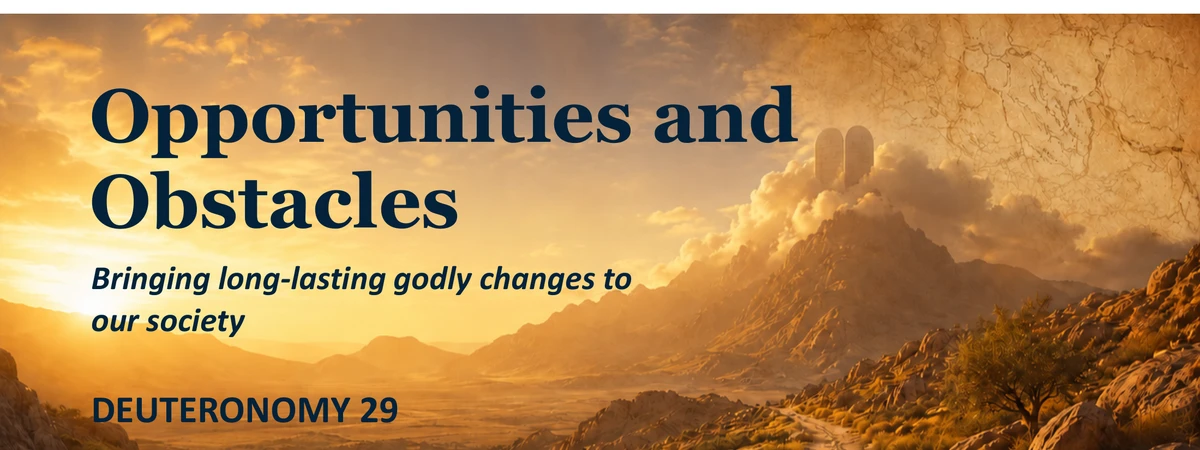
Deuternomomy 29 Opportunities and Obstacles
Deuteronomy 29 calls God’s people to remember His covenant works, recognize the hidden obstacles of the heart, and move forward in faithful obedience before the Lord. The chapter presses readers to look back at God’s proven faithfulness and look forward with a renewed commitment to walk in His revealed Word.
Deuteronomy 29 highlights the opportunities and challenges we face in obeying His covenant. This is not just a historical event but a present-day situation that each of us encounters. Will you and I choose to respond or to harden ourselves against His offered covenant?
Introduction
We cannot, dare not, say that God has not given us a chance. Looking back on history, we see God intervening in world events to bring great blessings to a people. Everything was provided so that the Israelites could be exceedingly blessed. We might think that after saying this, there would be a happy ending. But if you have read the Old Testament, besides a few scenes and eras here and there, it mostly records failures. God wanted to ensure the world understood how much God reached out to everyone and especially to one people. If God’s people fail, do not blame God. God made it possible for them to succeed, but they chose not to.
If we understand much of the New Testament, we will also see that we are on the verge of crossing the Jordan. Each generation is tested by receiving God’s truth. With it, they could succeed and bring God’s blessing to the whole world. By rejecting it, they would become selfish religious brats. Before us, we too have heard God’s truth.
“The secret things belong to the LORD our God, but the things revealed belong to us and to our sons forever, that we may observe all the words of this law. ((Deut 29:29).
This is our chance to make a difference. It is also our opportunity, though it could become our obstacle if we aren’t careful.
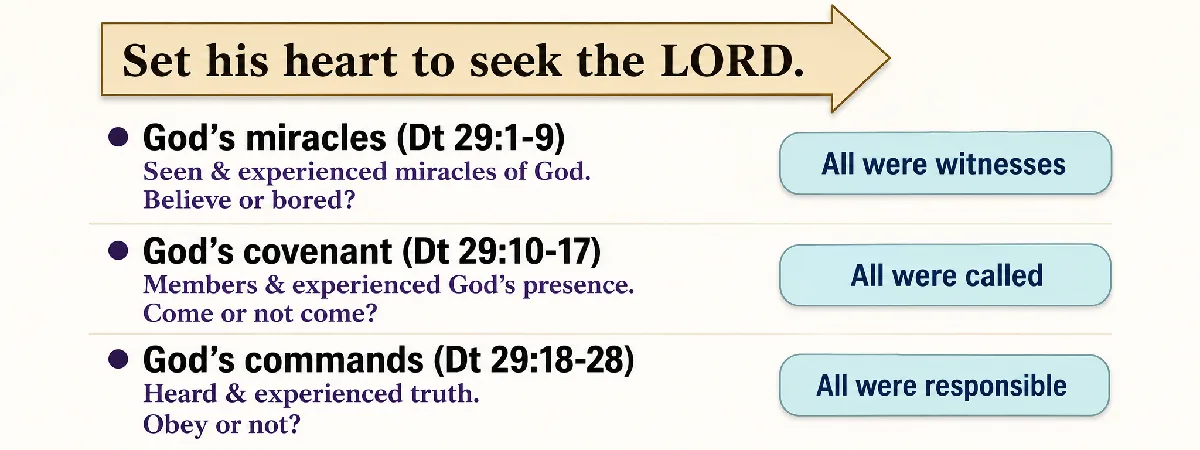
A. God’s miracles - All were witnesses (Deut 29:1-9)
We are all witnesses to His greatness.
We saw and believed.
We saw and are bored.
B. God’s covenant - All were called (Deut 29:10-18)
Everyone has part in God’s great covenant.
We are all members and sense its importance.
We were called but didn’t come.
C. God’s commands - All were responsible (Deut 29:14-28)
God has revealed His precious truth to us.
We heard and obeyed.
We didn’t care and did what we wanted.
Second Covenant
“These are the words of the covenant which the LORD commanded Moses to make with the sons of Israel in the land of Moab, besides the covenant which He had made with them at Horeb.” (Deuteronomy 29:1).
This is a historical event. The first covenant was given at Mt. Horeb or Mt. Sinai. This mountain has several names. It was a real mountain. There is debate about its exact location. We are still uncertain. Some have suggested that the original site in the Mt. Sinai desert is incorrect because there are other details that do not match that location. Ultimately, it doesn’t matter. Most importantly, we should not think of the making of this second covenant as a myth. All of Christianity is real, not myth. The Gnostic gospels are false because some elements are not real. This is what would happen if God let man control the making of the scriptures. However, God was in control, and He carefully preserved this knowledge through the scriptures.
A) God’s miracles - All were witnesses (Deuteronomy 29:1-9)
We must understand that as the Israelites approached making this solemn covenant, they needed to assure themselves that this was the covenant they truly wanted to establish. Typically, covenants are made by the victor in a battle with the defeated. The defeated have no choice but to accept the terms offered, which include both blessings and curses. This setup was quite common at the time. What is unusual is that God is so good and makes so many promises. God is committing Himself to these people.
Why would God, the Maker of the world, ever come to make such a covenant? This is a very important question because without it, we might not fully understand all the terms of the covenant. God has wonderfully worked in these people, making them His own. They were once ensnared and belonged to Pharaoh, the king of the world. When they cried out to Him, He delivered them. They then officially became God’s people. They belonged to Him.
This is a powerful teaching that is carried over into the New Covenant through Christ. We belonged to the world and were dominated by the evil one, but now we are set free to serve the Lord. Transitioning from one master to another, the first being a taskmaster and the new master one of love and care. There is no real contest of power; the Lord is greater in every way.
The Lord, however, is not just great in a powerful sense. He is creatively and delicately powerful. Usually, when we think of power, we think of a great force oppressing another. God does this, but with finesse. If we look at these miracles, we will see this very thing. The way God works will always surprise us because it is never the same. We, of course, see the same way God performs miracles through Jesus. They are unique. God is doing more than just showing power; He is displaying His marvelous might.
This makes God’s wrath very frightening. God does not simply destroy those who oppose Him. Judgment is described as a lake of fire that continues endlessly. It is a place where every action will be properly judged. Even in judgment, a wise and powerful balance is shown. Remember Lazarus and the rich man. The rich man had everything here, but there he suffered. God carefully measures how to judge each person based on their rebellion and pride. Never worry about God being unfair; He alone is the righteous judge. This personal judgment is necessary to truly deliver justice. If we reject His offer of grace in the covenant, we will face judgment along with the world. He discusses this later starting in 29:14.
“And Moses summoned all Israel and said to them, “You have seen all that the LORD did before your eyes in the land of Egypt to Pharaoh and all his servants and all his land; the great trials which your eyes have seen, those great signs and wonders. “Yet to this day the LORD has not given you a heart to know, nor eyes to see, nor ears to hear. “And I have led you forty years in the wilderness; your clothes have not worn out on you, and your sandal has not worn out on your foot. “You have not eaten bread, nor have you drunk wine or strong drink, in order that you might know that I am the LORD your God. “When you reached this place, Sihon the king of Heshbon and Og the king of Bashan came out to meet us for battle, but we defeated them; and we took their land and gave it as an inheritance to the Reubenites, the Gadites, and the half-tribe of the Manassites. “So keep the words of this covenant to do them, that you may prosper in all that you do. (Deuteronomy 29:2-9).
The Escape (Deuteronomy 29:2-4)
“And Moses summoned all Israel and said to them, “You have seen all that the LORD did before your eyes in the land of Egypt to Pharaoh and all his servants and all his land; the great trials which your eyes have seen, those great signs and wonders. Yet to this day the LORD has not given you a heart to know, nor eyes to see, nor ears to hear.” (Dt 29:2-4).
“In the land of Egypt to Pharaoh and all his servants and all his land the great trials which your eyes have seen, those great signs and wonders.”
The first point to mention, and one that cannot be ignored, is their escape as oppressed slaves in Egypt. There is no doubt that the ten plagues, along with how they gradually demonstrated God’s power over the gods of Egypt, revealed God as the God of gods. The Egyptians believed the Nile was a god. Most everything was considered divine. God was in control of all these things and, with great wisdom, showed that through these mighty signs and wonders. In a dramatic finale, we see them crossing on dry land as the same place becomes the tomb of the most powerful army on earth.
That generation by the edge of the Jordan was not alive to witness these great events firsthand, but it’s certain they heard all about it from their parents. Even their enemies knew very well how Egypt’s greatest power lost its dominance through this single people.
“For we have heard how the LORD dried up the water of the Red Sea before you when you came out of Egypt, and what you did to the two kings of the Amorites who were beyond the Jordan, to Sihon and Og, whom you utterly destroyed. (Joshua 2:10).
We can imagine that the Israelites spent most of their evenings listening to people recount the stories from when God defeated Egypt and led this people out of Egypt.
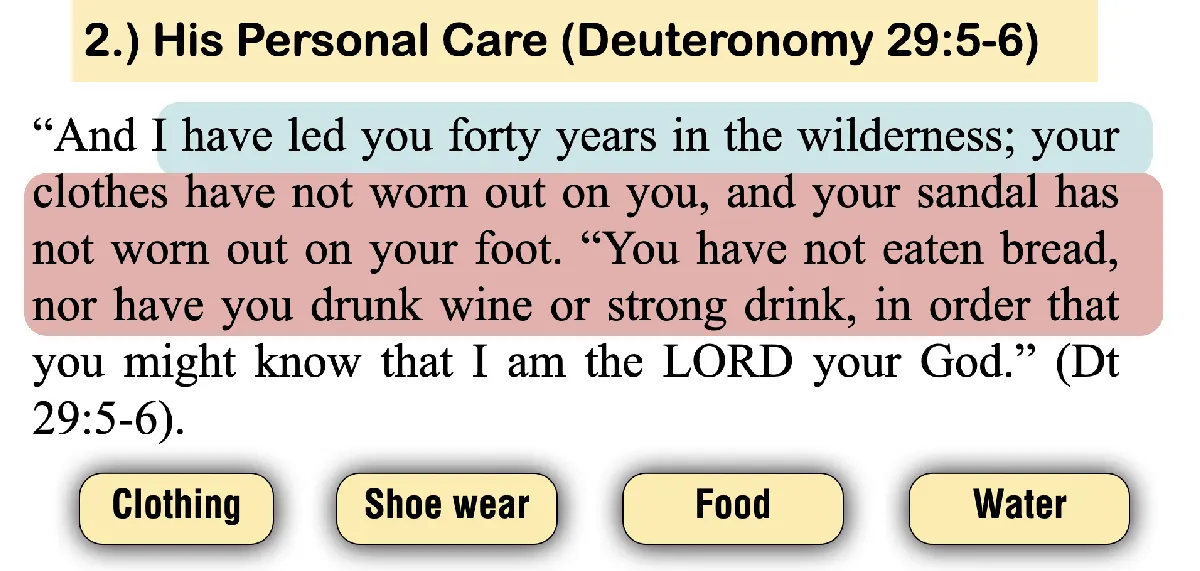
In Personal Care (Deuteronomy 29:5-6)
“led you forty years in the wilderness”
“your clothes have not worn out on you, and
“your sandal has not worn out on your foot.”
“You have not eaten bread, nor have you drunk wine or strong drink”
The second place where God revealed His amazing ways was in the wilderness. This was something even this generation saw. They marched in circles in one of the most deserted places on earth. It is nearly impossible for any great people to live there. Three million people had many personal needs. Moses listed several of them.
Their clothes did not wear out, which is incredible. Even with good clothing, nothing lasts forever, especially if it’s the only thing they have. On a tough journey, living all the time outdoors, they wore those clothes and sandals day after day. When my Dad was young, they would carry their good shoes to church to keep them clean. My sandals didn’t last a year! A friend bought me a pair of expensive sandals for my mission trip, but within a year, one sole fell off while I was walking.
This generation had God’s supernatural provision throughout their lives. They knew nothing else. After they crossed the Jordan River and ate the food there, the manna would cease. They were accustomed to a plentiful supply of clean, healthy water. They didn’t need to depend on wine. But once they crossed over, they had to fetch their own water. They had to make wine for drinking. Their clothes would begin to wear out, and their sandals would fall apart.
In Battle (Deuteronomy 29:7-8)
When you reached this place, Sihon the king of Heshbon and Og the king of Bashan came out to meet us for battle, but we defeated them; and we took their land and gave it as an inheritance to the Reubenites, the Gadites, and the half-tribe of the Manassites.
It’s incredible that even though this group was just wanderers in the desert, they defeated several armies and their kings. The armies had supplies, a safe home, and a place to keep their families and livestock during battles, but the Israelites had none of these. If they lost, they would have lost everything and been quickly overwhelmed by the enemies around them. These victories were won through God’s great and mighty power. God worked through the Israelite army to bring about these victories.
Summary
We discover that God’s power is executed with care and ingenuity. God is gentle in wielding His power when necessary. He can produce water from a rock in the wilderness and prevent a sandal from tearing. This power is truly extraordinary. The gods of other nations believed they could do one or the other, so they thought. The sun god would control the sun. The river god, the river. But God rules over everything. Even with our understanding of molecules, genes, and atoms, we cannot fully explain these phenomena. This generation has experienced it all.
Observation
We shouldn’t be too quick to move on, however. There is an interesting line that is carefully placed in this section: “Yet to this day the LORD has not given you a heart to know, nor eyes to see, nor ears to hear.” (Deuteronomy 29:4). We noted how the Lord provided so much for this generation; they experienced it firsthand (all but the deliverance). What can we say about verse 4? “They did not have a heart to know.”
The Israelites were blind to the great blessings we have. One son recently came to me and said he and his siblings didn’t realize how good it was growing up in a Christian home. Although I didn’t experience this myself, I understand what he meant. They were taking it all for granted, comfortable being surrounded by the truth. However, this didn’t mean they were ready for the world.
Knowing the truth in your mind isn’t the same as having an inner desire to understand and acquire it to shape your judgment. You might think the Israelites would have been very grateful and faithful to the Lord, but instead, they didn’t realize how fortunate they were and often complained.
The second generation
Many of you have grown up in Christian homes or are currently living in such homes. I hope that you will understand from this that you need your hearts to yearn to know, your eyes to truly see the power of the gospel, and your ears to genuinely want to listen to the amazing work of the Lord. Everything is true. I can live it out before you. You can observe the miracles and even treat them as a normal part of life. But unless you awaken to its real meaning, you will be held back. Let me say a special prayer for you.
“Dear Father in Heaven, I thank you for each and every child that has grown up in a Christian home. You know how easy it is for them to live near you without having you in their hearts. They get used to your ways and yet strip your special and unique way of working from their lives. Right now strip away all the layers of dullness over their hearts, eyes and ears. Wake them up. You are calling them too to draw close to you. Let not this generation be dumbed down as beasts without understanding, but open their eyes by your awesome grace so they can see and adore you. In Christ’s Name I pray, Amen.”
B) God’s covenant - All were called (Deut 29:10-17)
The Lord invites everyone into His presence. “For many are called, but few are chosen” (Matthew 22:14). What does this mean? Let’s first examine this passage more carefully, then proceed.
“You stand today, all of you, before the LORD your God: your chiefs, your tribes, your elders and your officers, even all the men of Israel, your little ones, your wives, and the alien who is within your camps, from the one who chops your wood to the one who draws your water, that you may enter into the covenant with the LORD your God, and into His oath which the LORD your God is making with you today, in order that He may establish you today as His people and that He may be your God, just as He spoke to you and as He swore to your fathers, to Abraham, Isaac, and Jacob” (Deuteronomy 29:10-13).
God was calling the people to join in confirming the covenant. The people need to bind themselves to it. Typically, people would, because of their defeat, just have to accept the terms or be killed. One threat later in history was that if you surrendered, every male would have an eye poked out. They didn’t like that and looked for a way to fight that enemy. It is different here. They were not obligated, but they were. They had already received so much from God. Should they submit to Him as a new generation? Look at this passage.
“Your chiefs, your tribes, your elders and your officers, even all the men of Israel, your little ones, your wives, and the alien who is within your camps, from the one who chops your wood to the one who draws your water.”
The leaders, each group (tribe), officials, men, women, and even little children were to come make the commitment to God. Even the alien that has joined them along the way and the slaves who chopped wood or draw water were to be included. We get a strong hint that this covenant is for all. No one was to be excluded, not matter race, color, age or sex.
The reason is clear (29:16-17). They all saw how they came out of Egypt; they, as one group, were delivered. Each person owes their life to God. We might find it difficult to understand the New Covenant’s differences. We escape from Satan’s grasp at different times. The Book of Acts records that 3000 people came to know the Lord in one day and 5000 on another. People are coming to know the Lord day by day. But if we look back, it’s because of what happened to Jesus on the cross and His resurrection afterward. Satan was then defeated. God secured His people at that time, even though they were not yet saved. That’s why some scriptures speak of the body of Christ as one being saved, even if they think differently.
“Moreover, you have seen their abominations and their idols of wood, stone, silver, and gold, which they had with them.”
This is especially for those who are here because of someone else. They might be okay with it, but that doesn’t mean they are serious. If it works out well for them, then fine, but if not, they will stop coming. The Lord was very specific that everyone should be part, and the same is true for us today.
C) God’s commands - All were responsible (Deut 29:18-28)
“And he did evil because he did not set his heart to seek the LORD” (2 Chronicles 12:14).
It is clear that the Lord was making this covenant with all the people who came before Him to enter into it. However, some questions remain. What about those stubborn Israelites who had no intention of joining the others in making this covenant? They might have been too busy. Their job could have been their idol. Their food might have been more important than spiritual matters. They could have been involved in other concerns. Or they simply might not have cared about it at all.
“Now not with you alone am I making this covenant and this oath, but both with those who stand here with us today in the presence of the LORD our God and with those who are not with us here today” Deuteronomy 29:14, 15).
Lest there shall be among you a man or woman, or family or tribe, whose heart turns away today from the LORD our God, to go and serve the gods of those nations; lest there shall be among you a root bearing poisonous fruit and wormwood. “And it shall be when he hears the words of this curse, that he will boast, saying, ‘I have peace though I walk in the stubbornness of my heart in order to destroy the watered land with the dry.” (Deuteronomy 29:17-19)
The rest of the chapter describes how the Lord will first single them out to preserve the whole (29:20-21). If unbelief spreads, then He will judge the entire nation (29:22-28). The last section (22-28) is written differently from the previous parts, so at first, it might be confusing, but if one reads through Deuteronomy, they will surely grasp the message. Moses repeats it again and again. It is clear, however, that the Lord is no longer addressing just individuals but the entire land.
Theology of Security
We need to clarify some thoughts about our salvation here. We often get confused because we conflate two teachings: security of salvation and discipline. This passage does not speak about whether they were part of the covenant. Surely they were, even if they did not stand that day with the others as they made their pledges. As part of the community, they were under the Old Covenant. The only way out would be to leave the community. If they lived under it, however, then they would live under the covenant’s terms.
This passage does not address a person losing his salvation. The Old Testament discusses this issue, as does the New Testament, but not here. Only some of the Old Covenant involved saving faith. The Old Covenant itself did not save in the way we typically understand salvation. It brought people near to God, but it did not necessarily mean they had faith in God.
“Moreover the LORD your God will circumcise your heart and the heart of your descendants, to love the LORD your God with all your heart and with all your soul, in order that you may live” (Deuteronomy 30:6).
“Circumcise yourselves to the LORD And remove the foreskins of your heart, Men of Judah and inhabitants of Jerusalem, Lest My wrath go forth like fire And burn with none to quench it, Because of the evil of your deeds” (Jeremiah 4:4).
“But he is a Jew who is one inwardly; and circumcision is that which is of the heart, by the Spirit, not by the letter; and his praise is not from men, but from God” (Romans 2:29).
The Old Covenant was not a salvation covenant like the new one. It only secured promises from God for their life on earth. But within this whole covenant, they could be truly circumcised in heart. They could, that is, genuinely believe and receive a new nature by God’s mercy. It would be through faith, just like with the New Covenant. And salvation would be, as with the New, based on the work of Christ (the Messiah).
Having said that, we should realize that not everyone in the New Covenant is saved. Some appear to be saved, but they are not. This is because they were never truly of the faith. Judas Iscariot is an example. John describes this, “They went out from us, but they were not really of us; for if they had been of us, they would have remained with us; but they went out, in order that it might be shown that they all are not of us” (1 John 2:19).
The main idea in Deuteronomy is that we can’t have casual faith. A casual, superficial, or convenient faith isn’t a true faith. If you don’t actively seek the Lord, your faith isn’t genuine. You can’t simply coast into God’s kingdom. Jesus emphasized this with His words, Love God with all your heart, soul, and mind. Or “Take up the cross and follow Me.” There are no in-between steps.
A casual faith might seem okay because you usually go along with God’s people. But since you don’t truly love the Lord or His people, you can easily be like a ship caught in a storm without any power. You will be set loose, as John says, and one day you’ll find yourself apart from God’s people.
Now is the day of salvation. I ask you, are you one of those with a casual faith? Maybe your parents or friends are Christians, but you’ve never really thought about whether you’ve sought the Lord. Today is the day. Don’t be like someone who just complains about prayer meetings and long services, or who comes and goes from church without truly committing, like those who didn’t participate in the making of the covenant.
“And he did evil because he did not set his heart to seek the LORD. (2 Chronicles 12:14)
Conclusion
You will end up doing wrong if you do not seek the Lord. King Rehoboth, King Solomon’s son, did well for the first few years, but this statement was later said of him. He did not truly seek the Lord, and so evil came upon him. I ask you, “Do you seek the Lord?” Is the Lord your first love? Are you genuinely seeking His will, or are you just taking things from Him so you can live your own life the way you want? What is your heart like? Seek Him now. Repent if necessary. Find Christ if you have not known Him. Now is the day of salvation. You might not have another one.
Deuteronomy 29 Study Questions
- What mighty works of the Lord does Deuteronomy 29 call Israel to remember?
- Why is remembering God’s faithfulness essential before looking forward?
- What hidden obstacles in the heart does this chapter warn against?
- How can covenant privilege become dangerous if it leads to presumption rather than obedience?
- What does Deuteronomy 29:29 teach about revealed truth and obedience?
- How should parents and leaders pass on God’s revealed Word to the next generation?
- Where do you need to “look back” at God’s faithfulness so you can “look forward” with renewed trust?