Written by Paul J Bucknell on May, 22, 2026
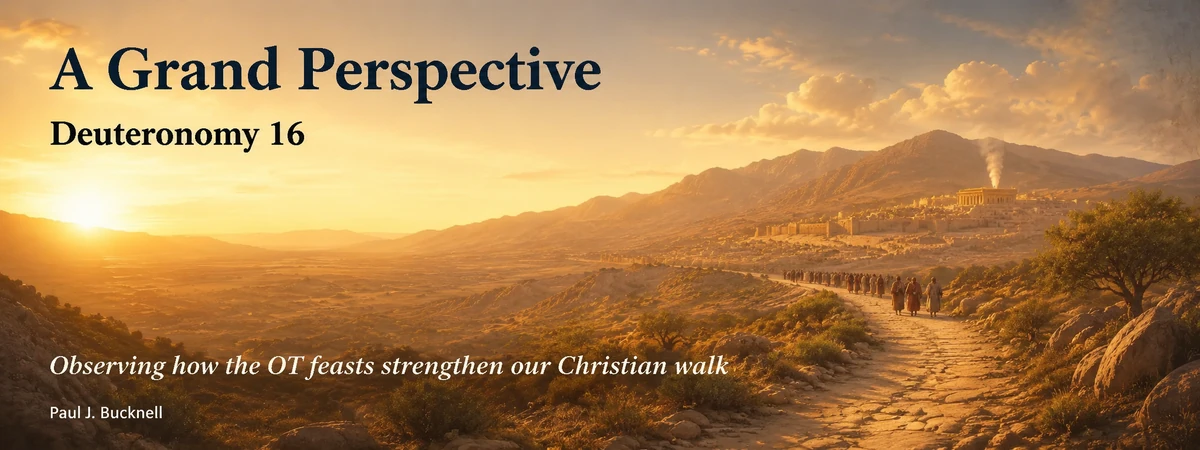
Deuteronomy 16 A Grand Perspective of Time: Observing how the OT feasts strengthen our Christian walk
If I asked you, “What three truths are essential to being a good Christian?” what would you say? There would probably be many confused answers. How does someone decide what they do, say, or pursue? I also had no good answer for this until I prepared this message. Then it became clear. Surprisingly, the Lord doesn’t give us a systematic theology to offer perspective. Instead, He shapes the way we live, think, and choose.
Our humanistic society is self-centered. Everything focuses on themselves or what they believe is important, rather than on God and what He says. They have excluded the Lord God from their understanding. As a result, everything becomes distorted. That is why modern man often feels a lack of true purpose in life and can easily fall into depression. He is simply a temporary collection of chemicals or a surge of feelings, depending on perspective. Life doesn’t make sense until we understand how we fit into God’s plan.
People often feel that they are the most important beings in the universe. When young, they feel as if they have unlimited time. Time seems insignificant. After all, they believe they have their whole lives ahead of them! Time doesn’t seem to affect them. But as time passes and they grow older, they begin to feel time gripping them tightly. Time appears like a stern ruler controlling everything they do. However, from God’s perspective, all of this—including time itself—is trivial. God is eternal. He exists beyond time. To eternity, time is just a tiny speck, almost as if it never existed, though it did.
What happens in time is very significant, though. We want to understand what happened and why, and see how our lives relate to these events. It is here that we find meaning and purpose in life. Fortunately, God takes time to explain these things to us.
God embedded this plan in the scriptures. The Lord wants His people to understand His plan. It provides us with a broad overview, not of everything, but of what matters most to us. We cannot have a perfect, complete understanding of all things, just as a baby in the womb cannot comprehend the sun. Yet, God makes efforts to help us grasp what truly matters. He does this through the scriptures, especially in the passage we find in Deuteronomy 16.
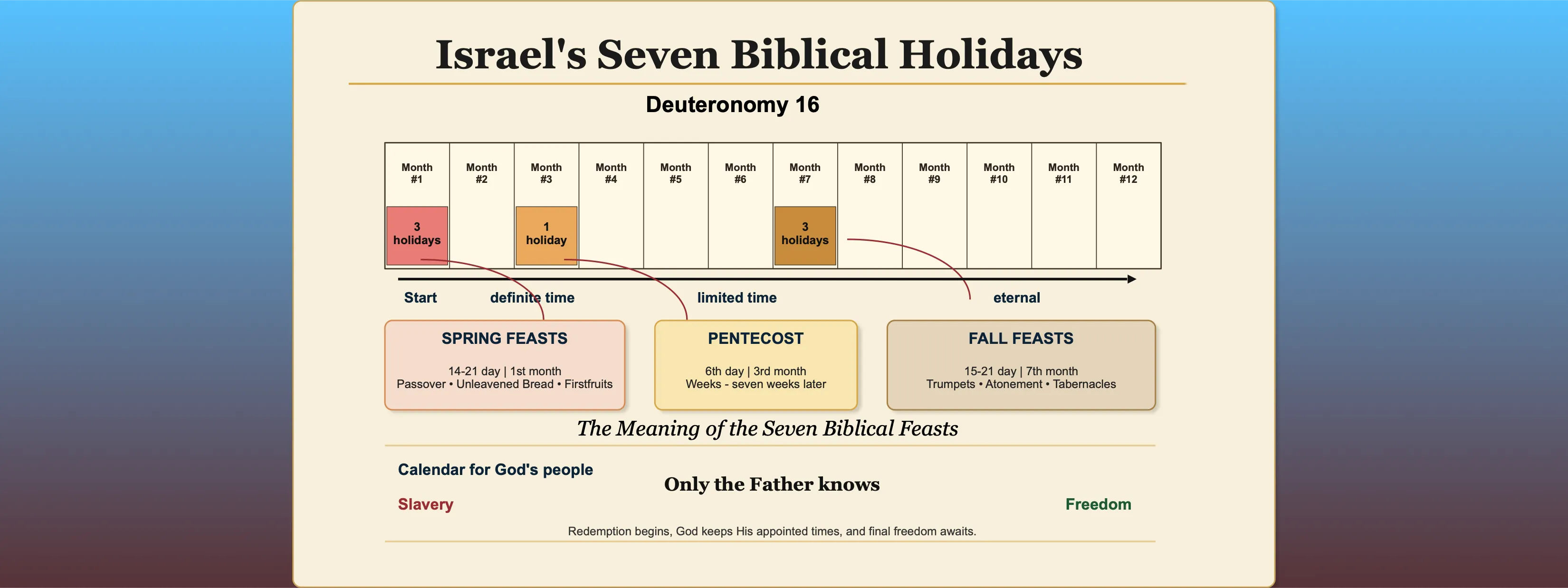
There were a total of seven biblical holidays for God’s people in the Old Testament. This became their worship calendar, which in turn shaped their lives. Jewish men were required to attend three of these each year.
“Three times in a year all your males shall appear before the LORD your God in the place which He chooses, at the Feast of Unleavened Bread and at the Feast of Weeks and at the Feast of Booths, and they shall not appear before the LORD empty-handed. 17 Every man shall give as he is able, according to the blessing of the LORD your God which He has given you.” (Deuteronomy 16:16-17 NASB).
The Israelites were not asked for their opinion about this proposal. God’s Word guided their actions. Life revolved around what the Lord, our Creator, has spoken. Worship, therefore, is aligning with God’s purposes.
Seven Holidays
While properly observing these holidays, they would need to plan their schedules around God’s requirement that all men travel three times a year to worship the Lord at the designated place. Pay attention to how important this is.
16:06 “Lord your God chooses.”
16:11 “Lord your God chooses.”
16:15 “the Lord chooses.”
16:16 “He chooses.”
We discussed that this place was Jerusalem in our study of Deuteronomy 14 because David placed it there. Now, in the New Testament, it is not limited by location because each of God’s people is a walking temple. God resides in the individual. If we examine many verses closely, we will see that Jerusalem was not emphasized; instead, the most important aspect was in the person of David’s descendant.
“And it shall come about when your days are fulfilled that you must go to be with your fathers, that I will set up one of your descendants after you, who shall be of your sons; and I will establish his kingdom. “He shall build for Me a house, and I will establish his throne forever.” 1 Chronicles 17:11, 12, NASB.
Although there are seven biblical holidays, they are grouped into three main periods. People did not celebrate the Feast of Passover alone; two other holidays occur at the same time: the Feast of Unleavened Bread and the Day of Firstfruits. The same pattern applies to the Feast of Tabernacles, the last feast. The Feast of Trumpets and the Day of Atonement precede the Feast of Tabernacles. This way, people could participate in all the holidays simply by attending the three main ones.
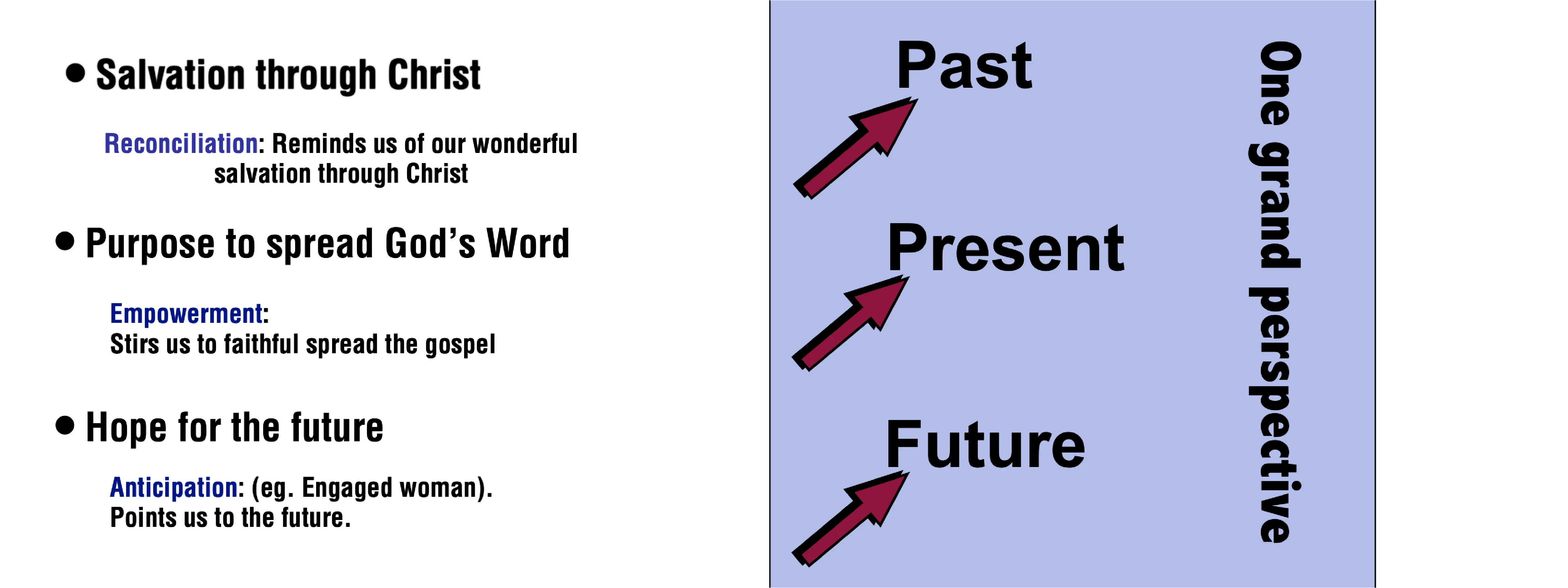
These three holiday seasons are meant to give us a perspective on how we should view our salvation and live out our Christian lives. It is in the details of the calendar that we will find a comprehensive plan to help us better understand Christian living. Perhaps we will even discover the three most important things that should influence our lives as believers. The Old Testament, of course, is only a shadow of the more glorious New Covenant that the Lord established through Jesus. We shouldn’t be surprised that all these feasts focus on God’s plan for us through Christ our Savior. So let’s step in and gain a clearer understanding of this comprehensive view of Christian living. We will focus on three events, each representing a very significant part of the believer’s life.
We can consider them from different perspectives.
1) The Feast of Unleavened Bread (the beginning) (Dt 16:1-8)
Reconciliation - relationship
Reminds us of the amazing salvation we have through Christ’s death and resurrection..
2) The Feast of Harvest (the firstfruits) (Dt 16:9-12)
Empowerment - purpose
Stirs us to faithfully spread the gospel
3) The Feast of Ingathering (the end) (Dt 16:13-15)
Perspective - hope
Points us to look to the future.
Summary: (Dt 16:16-17)
A) The Feast of Passover reminds us of our salvation (Deuteronomy 16:1-8)
“Observe the month of Abib and celebrate the Passover to the LORD your God, for in the month of Abib the LORD your God brought you out of Egypt by night. “And you shall sacrifice the Passover to the LORD your God from the flock and the herd, in the place where the LORD chooses to establish His name. “You shall not eat leavened bread with it; seven days you shall eat with it unleavened bread, the bread of affliction (for you came out of the land of Egypt in haste), in order that you may remember all the days of your life the day when you came out of the land of Egypt. “For seven days no leaven shall be seen with you in all your territory, and none of the flesh which you sacrifice on the evening of the first day shall remain overnight until morning. “You are not allowed to sacrifice the Passover in any of your towns which the LORD your God is giving you; but at the place where the LORD your God chooses to establish His name, you shall sacrifice the Passover in the evening at sunset, at the time that you came out of Egypt. “And you shall cook and eat it in the place which the LORD your God chooses. And in the morning you are to return to your tents. “Six days you shall eat unleavened bread, and on the seventh day there shall be a solemn assembly to the LORD your God; you shall do no work on it”( Deuteronomy 16:1-8). (Also see Exodus 12).
1) The Feast of Passover (First month, 14th day)
The first feast was the Passover. The Lord specified when and how they should observe this feast. Passover took place on the 14th day of the first month of the Israeli calendar. Before this, they endured 13 years of slavery. They were in Egypt, serving a tyrant. On the 14th, the Lord would deliver them and lead them from Egypt to the Promised Land.
They were to make a special sacrifice of an unblemished lamb, which became the centerpiece of the meal they were to eat while standing. Moses does not go into detail here. There are many details, and each one is significant. We will not discuss them now. Read more in Exodus 12.
More importantly, what the Passover represents is essential. The lamb provided the blood that was to be placed on the doorposts to keep the angel of death away. This lamb symbolizes Jesus Christ, who laid down His life for His people. Only those who ate the lamb and were protected by the blood would be saved. As a result, they would leave Egypt, the world. They were set free, but they would need to live differently now that they were in God’s presence. We will talk more about this soon. But first, let’s look at how Jesus saw Himself as the sacrifice for God’s people.
“And He said to them, “I have earnestly desired to eat this Passover with you before I suffer; for I say to you, I shall never again eat it until it is fulfilled in the kingdom of God.” And when He had taken a cup and given thanks, He said, “Take this and share it among yourselves; for I say to you, I will not drink of the fruit of the vine from now on until the kingdom of God comes.” And when He had taken some bread and given thanks, He broke it, and gave it to them, saying, “This is My body which is given for you; do this in remembrance of Me.” And in the same way He took the cup after they had eaten, saying, “This cup which is poured out for you is the new covenant in My blood. “But behold, the hand of the one betraying Me is with Me on the table.” Luke 22:15-21, NASB.
“Knowing that you were not redeemed with perishable things like silver or gold from your futile way of life inherited from your forefathers, but with precious blood, as of a lamb unblemished and spotless, the blood of Christ.” 1 Peter 1:18, 19, NASB.
The blood is valuable because it comes from Jesus Christ, God’s only Son. It was His righteous life for our unrighteous one. Only through faith in Christ can a person be saved. Only those firstborn under the protection of the blood would not die when the angel of death passed over.
Application
Have you believed in Jesus Christ? Have you seen the destruction and judgment caused by your sin and are you seeking cleansing? Christ is the answer and the only way to God the Father.
2) The Feast of Unleavened Bread (First month, 14-21st day)
In 16:3, Moses discusses the Feast of Unleavened Bread, which actually started on the same day as Passover. Leaven represents sin. They were instructed to thoroughly clean their houses and remove any leaven. God would dwell among them, so they needed to live a pure life. Similarly, Christians are called to live holy lives, as God desires to dwell within them. Leaven is simply a symbol of sin — if we remove it completely, we are free from it. But if we don’t, yeast will multiply and contaminate the whole loaf. Listen to the words of the Apostle Paul.
“Clean out the old leaven, that you may be a new lump, just as you are in fact unleavened. For Christ our Passover also has been sacrificed.” 1 Corinthians 5:7, NASB.
Application
Every believer must drive sin out of their house. The idea of a worldly believer doesn’t work. You can’t say that the leaven is gone when you keep some in your pocket. Either you are in Egypt or you are out of Egypt. If we hold onto worldly tendencies, there is a real risk that, like Lot’s wife, we focus more on what we left behind than on where we are headed.
3) The Day of First Fruits (First month, 16th day)
This day isn’t specifically mentioned or referenced here, but it is definitely one of the seven special holy days or feasts. If you’re in Jerusalem for the Feast of Unleavened Bread, you’ll also be there for the Day of First Fruits, which happens on the third day after Passover. You may have noticed the event and the date: the lamb was sacrificed on the first day (Jesus died), and on the third day, this feast was celebrated (Jesus’ resurrection occurred). That’s what the Day of First Fruits represents. Again, it’s not mentioned here because this is an overview; too many details could cause confusion. This is from Deuteronomy, where the focus is on bringing the people’s hearts and minds back to the covenant their ancestors rejected.
Summary (Dt 16:1-8)
Passover, the Feast of Unleavened Bread (the start), and the Day of First Fruits all mark the beginning of the calendar. Once Christ died, the calendar started. It was a sad, even tragic, beginning, but it was also one where the mighty God showed great compassion by sending His only Son to die for us. Through Jesus Christ’s death and resurrection, we can become part of God’s family. We are reconciled and have a restored relationship with God. Of course, this also means we need to live holy lives, which involves removing sin (leaven) from our lives.
Three of the first holy days are mentioned here, each pointing to the source and nature of our salvation. Through Christ’s blood, we are set free from the world and, by the power of the resurrection, called to live holy lives in God’s presence.
B) The Feast of Weeks reminds us of our holy behavior (Deut 16:9-12)
“You shall count seven weeks for yourself; you shall begin to count seven weeks from the time you begin to put the sickle to the standing grain. “Then you shall celebrate the Feast of Weeks to the LORD your God with a tribute of a freewill offering of your hand, which you shall give just as the LORD your God blesses you; and you shall rejoice before the LORD your God, you and your son and your daughter and your male and female servants and the Levite who is in your town, and the stranger and the orphan and the widow who are in your midst, in the place where the LORD your God chooses to establish His name. “And you shall remember that you were a slave in Egypt, and you shall be careful to observe these statutes” ( Deuteronomy 16:9-12).
1) A Description of Pentecost
This fourth celebration is the Feast of Weeks. Notice the difference between this holiday and the previous one. Its celebration is tied to the previous one, depending on how much time passes between them. One is to count seven weeks, then they put the sickle to the standing grain.
“Until this same day, until you have brought in the offering of your God, you shall eat neither bread nor roasted grain nor new growth. It is to be a perpetual statute throughout your generations in all your dwelling places.” Leviticus 23:14, NASB.
In other words, fifty days after the seventh Sabbath, they were instructed to make an offering (Leviticus 23:16). These are guidelines for those under the Old Covenant. Under the New Covenant, there is no need to strictly follow them. However, we should remember that this festival was so important that all men across the land were expected to go to Jerusalem to participate in it. So, let’s ask ourselves, what happened seven weeks after the Day of First Fruits? Or rephrase it: what occurred fifty days after Christ’s resurrection? Let’s turn to the scriptures and see how this is answered.
“And when the day of Pentecost had come, they were all together in one place. And suddenly there came from heaven a noise like a violent, rushing wind, and it filled the whole house where they were sitting. ” Acts 2:1-2.
“And with many other words he solemnly testified and kept on exhorting them, saying, “Be saved from this perverse generation!” So then, those who had received his word were baptized; and there were added that day about three thousand souls.” Acts 2:40-41.
The Holy Spirit was not only poured out, but His work was incredibly powerful. Many people came to know the Lord. Thousands of the most hardened hearts were transformed. Pentecost literally means “fifty.” It followed the work of Christ on the cross and His resurrection. It was all carefully planned by the One who designed the holiday. Actual celebrations were established to emphasize God’s grace in the world. This is truly remarkable.
2) The Significance of Pentecost
It is clear that the Holy Spirit was poured out on mankind at that time, marking the first harvest—specifically, the salvation of many people under the New Covenant, which was just ratified by Jesus’ death. However, we should be careful to understand that there was more to what was happening.
- First of many harvests (character of gospel age)
This was the first of many harvests. We should not think there were only a few. It was the first fruits when people gave great praise to God. Jesus had gone above and sent the Holy Spirit down to bring a great work among men. We should expect more people to be saved. God cares about barley, but He cares even more for lost souls.
“And He, when He comes, will convict the world concerning sin, and righteousness, and judgment;” John 16:8, NASB.
“And He said to them, “Thus it is written, that the Christ should suffer and rise again from the dead the third day; and that repentance for forgiveness of sins should be proclaimed in His name to all the nations, beginning from Jerusalem.” Luke 24:46, 47, NASB.
- Holy Spirit’s indwelling (power of the gospel age)
The work of the Holy Spirit in believers’ lives is the same for us as it was for them. The New Testament description of what the Lord was doing remains true for us regarding how the Holy Spirit dwells in God’s people and works through their lives. You are not an orphan if you believe in Christ. You might feel alone, rejected, or abandoned, but as God’s child, you are not. You cannot be. God’s Spirit lives in you in a powerful and mysterious way. This leads to the third important point.
- Purpose to share the gospel (design of the gospel age)
The Lord plans to work through the Holy Spirit in you to save the lost. We do not personally save the lost; God’s Spirit does the actual work. However, we partner with the Holy Spirit in sharing God’s Word with others. Evangelism is not just something we might do, but something God clearly intends to accomplish through our lives.
Application
Salvation is important, and our holy living is necessary. Here, we learn how the Holy Spirit truly dwells in believers, which is a key trait of those under the New Covenant. It is unfortunate that the Holy Spirit is often seen as belonging only to a specific group or denomination. Pentecost marked the coming of the Holy Spirit, inaugurating the New Covenant. We shouldn’t focus on speaking in different languages to prove we have the Holy Spirit but on finding opportunities to share the gospel of Jesus Christ. If we need to speak in other languages, we can ask Him for this gift as well.
The Holy Spirit then works within us to give us new life, bringing new believers into the faith, and strengthening them to speak His powerful Word so that others may be saved. I don’t know what you consider the purpose of your life to be. What are you living for? I sincerely hope it aligns closely with the Holy Spirit’s work in and through your life.
We are saved with a purpose. We become part of the great process in which others are brought into the New Covenant. This is our sacred worship. It began on the Day of Pentecost and has shaped how we should live ever since.
C) The Feast of Booths reminds us of our eternal home (Deut 16:13-17)
“You shall celebrate the Feast of Booths seven days after you have gathered in from your threshing floor and your wine vat; and you shall rejoice in your feast, you and your son and your daughter and your male and female servants and the Levite and the stranger and the orphan and the widow who are in your towns. “Seven days you shall celebrate a feast to the LORD your God in the place which the LORD chooses, because the LORD your God will bless you in all your produce and in all the work of your hands, so that you shall be altogether joyful” ( Deuteronomy 16:13-15).
The last celebration is the Feast of Booths, also called Tabernacles, which happens in the seventh month. There are three holidays in this month. Only the last one is mentioned here, but I’ll briefly explain what led up to this final celebration in the same month.
1) Feast of Trumpets
The Feast of Trumpets occurred on the first day of the seventh month. It was announced by a loud trumpet call, urging everyone to prepare for the Day of Atonement, which happens ten days later. Today, the Feast of Trumpets is commonly called Rosh Hashanah. This was a call for everyone to believe in Jesus Christ in preparation for Judgment Day. The Lord desires everyone’s salvation. By issuing this great call to get ready, the lost are invited to turn to Christ through a powerful work of the Holy Spirit.
There are various interpretations of this event. It is only mentioned in two verses (Leviticus and Numbers). It is not referenced here in Deuteronomy. Its importance mainly comes from the Day of Atonement, which follows it. So, how else should we prepare for judgment than by humbling our hearts, turning from our sins, and looking to the Savior?
This is something that Christians are called to do from the earliest feast. Listen to how the message of repentance was, and still is, shared today.
“And Peter said to them, “Repent, and let each of you be baptized in the name of Jesus Christ for the forgiveness of your sins; and you shall receive the gift of the Holy Spirit.” Acts 2:38, NASB.
“Repent therefore and return, that your sins may be wiped away, in order that times of refreshing may come from the presence of the Lord;” Acts 3:19, NASB.
It seems that this day is different because it will suddenly trigger a series of events planned for the last days before Judgment Day, which the Day of Atonement signifies. Like Nineveh, the Feast of the Trumpets serves as a warning to heed the call for repentance as the end of the world and its judgment approach. The clock has begun ticking. There are several signs we see at the end of the age. In the Book of Revelation, a series of trumpets is sounded. With each blast, catastrophic scenes unfold on the earth. This serves as a preparation for the final judgment. Each is a call to prepare before it is too late. This will bring in the last group of people to come to the Lord. Many will refuse, but many will accept. Perhaps this will also bring about the final harvest.
Some believe this feast refers to the rapture, where believers will be taken up before judgment falls on the earth. I like the meaning, but I unfortunately see no proof of this in the scriptures. The rapture, as spoken of in 1 Thessalonians 4, is the end.
Perhaps this will also mark the time when the Gentiles around the world have believed, but now the hearts of the Jews are opened. Many Jews might come to Jesus Christ. This would be a sign that judgment is near. The final harvest is just around the corner. After all, if in the first harvest many Jews came to know the Lord Jesus as Messiah, then surely this could be the last.
Application
When we preach the gospel, we should not hesitate to call people to repent. We do not need to make the gospel easy. This deceives people. If the Holy Spirit is working, then He will convict them. Repentance is the process of preparing the heart through the power of the Gospel for the Day of Judgment. Those who believe in Christ will be saved. Christ is coming. The hope for the lost will soon be extinguished.
“And He shall send His angels with a great sound of a trumpet, and they will gather together His elect from the four winds, from one end of heaven to the other. (Matthew 24:31)
“ . . . in a moment, in the twinkling of an eye, at the last trumpet. For the trumpet will sound, and the dead will be raised incorruptible, and we shall be changed. (I Corinthians 15:52; see I Thessalonians 4:16)
“So the seven angels who had the seven trumpets prepared themselves to sound. The first angel sounded. . . . Then the second angel sounded. . . . Then the third angel sounded. . . . Then the fourth angel sounded. . . . Then the fifth angel sounded. . . . Then the sixth angel sounded. . . . Then the seventh angel sounded: And there were loud voices in heaven, saying, “The kingdoms of this world have become the kingdoms of our Lord and of His Christ, and He shall reign forever and ever!” (Revelation 8:6-8, 10, 12; 9:1, 13; 11:15)
“Blow the trumpet [shophar] in Zion; sound the alarm on my holy mountain! Let all the inhabitants of the land tremble, for the day of the Lord is coming, it is near” (Joel 2:1).
2) Day of Atonement
The Day of Atonement symbolizes Judgment Day, exactly ten days after the call to repentance. There is no hope afterward. Either a person has believed in the Gospel, or they have not. Either you will have Jesus Christ the Righteous to cover your sins, or you will need to suffer for your own arrogance and defiance against the Lord. Let us listen to the testimony of the scriptures.
“Because He has fixed a day in which He will judge the world in righteousness through a Man whom He has appointed, having furnished proof to all men by raising Him from the dead.” Acts 17:31, NASB.
“We must work the works of Him who sent Me, as long as it is day; night is coming, when no man can work.” John 9:4, NASB.
“Heaven and earth will pass away, but My words shall not pass away. “But of that day and hour no one knows, not even the angels of heaven, nor the Son, but the Father alone. “For the coming of the Son of Man will be just like the days of Noah.” Matthew 24:35-37, NASB.
Once the new year begins, it will come to an end. The world as we know it will not last forever. Whether you’re ready or not, the time is approaching. The call to repent has already been made. Now, only the end remains.
Application
God will judge us fairly, but that is what should scare us. We can fool ourselves and others, but we cannot fool God. God sees our motivation and reasons for doing things. He sees our greed, disobedience, and evil hearts. More importantly, once Judgment comes, it is too late. Don’t think you will change your mind at the last moment. Do not trust in your so-called good works, because you will perish with them. God is holy, and His standard is perfection. We are not saved by being good because we cannot be. Our hope must be that our name is written in the Lamb’s Book of Life. He has called us all to live uprightly, but as the scriptures say, we have all gone astray, each to his own way. Now is the time to repent and believe in Christ. Then you will be saved.
3) Feast of Tabernacles
We have reached the last festival mentioned: the final harvest. We need to see the calendar year in a special way. Once Passover begins, the Gospel Age has started. Pentecost arrived exactly on time. The Holy Spirit empowers all of God’s people to live for Him and to share the Gospel.
Did you notice that the Day of Judgment, the Day of Atonement, was not the last event? No, it’s not the end at all. The last feast that everyone was required to attend was the Feast of Tabernacles.
This marked the year's final harvest. It lasted for a week. Interestingly, they were to live in tents, symbolizing the time the Israelites spent wandering in the wilderness before reaching the promised land. They were heading to the Promised Land. Once they arrived, they wouldn’t need to use their tents (also called tabernacles) anymore. Of course, this is a picture of our feast with the Lord and all the saints. Earthly life has ended; the picture of eternal life has arrived.
“For we know that if our earthly house of this tabernacle were dissolved, we have a building of God, an house not made with hands, eternal in the heavens. For in this we groan, earnestly desiring to be clothed upon with our house which is from heaven.” -2 Corinthians 5:1-2
On the last Day of the Feast, Jesus stood up and said, “If any man is thirsty, let him come to Me and drink. He who believes in Me, as the Scripture said, ‘From his innermost being shall flow rivers of living water” (John 7:37-38). (Read more).
In the Book of Revelation, we learn that after the judgment, a very special event took place. Do you remember what it was? It was the wedding. Earlier, Jesus spoke about wanting the banquet hall to be full of people. It would be the great marriage feast of the Lamb, where all believers from all times are gathered together.
“After these things I heard, as it were, a loud voice of a great multitude in heaven, saying, “Hallelujah! Salvation and glory and power belong to our God; BECAUSE HIS JUDGMENTS ARE TRUE AND RIGHTEOUS; for He has judged the great harlot who was corrupting the earth with her immorality, and HE HAS AVENGED THE BLOOD OF HIS BOND-SERVANTS ON HER.” And a second time they said, “Hallelujah! HER SMOKE RISES UP FOREVER AND EVER.” And the twenty-four elders and the four living creatures fell down and worshiped God who sits on the throne saying, “Amen. Hallelujah!” And a voice came from the throne, saying, “Give praise to our God, all you His bond-servants, you who fear Him, the small and the great.” And I heard, as it were, the voice of a great multitude and as the sound of many waters and as the sound of mighty peals of thunder, saying, “Hallelujah! For the Lord our God, the Almighty, reigns. “Let us rejoice and be glad and give the glory to Him, for the marriage of the Lamb has come and His bride has made herself ready.” And it was given to her to clothe herself in fine linen, bright and clean; for the fine linen is the righteous acts of the saints. And he *said to me, “Write, ‘Blessed are those who are invited to the marriage supper of the Lamb.’” And he *said to me, “These are true words of God.”” Revelation 19:1-9, NASB.
Nothing will interrupt the marriage between God’s people and the Lamb. This refers to the ongoing, eternal new age. It does not describe a millennium of exactly 1000 years but rather eternity spent in the Lord’s love. There is no scripture suggesting this as only a 1000-year picture. Remember that the tent itself was a symbol of something temporary. That is completely opposite to the beauty of a relationship that will never end. We are promised eternal life, not just 1000 years.
Application
“In My Father’s house are many dwelling places; if it were not so, I would have told you; for I go to prepare a place for you. “And if I go and prepare a place for you, I will come again, and receive you to Myself; that where I am, there you may be also. “And you know the way where I am going.” Thomas said to Him, “Lord, we do not know where You are going, how do we know the way?” Jesus said to him, “I am the way, and the truth, and the life; no one comes to the Father, but through Me. “If you had known Me, you would have known My Father also; from now on you know Him, and have seen Him.” Philip *said to Him, “Lord, show us the Father, and it is enough for us.” John 14:2-8, NASB.
Note how the ‘place’ refers to a room or a permanently protected location, unlike the image of a tent that can be taken down and then rebuilt.
Summary (Deuteronomy 16:16-17)
Three times in a year all your males shall appear before the LORD your God in the place which He chooses, at the Feast of Unleavened Bread and at the Feast of Weeks and at the Feast of Booths, and they shall not appear before the LORD empty-handed. “Every man shall give as he is able, according to the blessing of the LORD your God which He has given you” (Deuteronomy 16:16-17).
Every feast requires a Jew to make an annual pilgrimage to the place designated by the Lord. Each time, an offering is necessary. Do not come empty-handed. They had to structure their lives around these times.
“And I am no more in the world; and yet they themselves are in the world, and I come to Thee. Holy Father, keep them in Thy name, the name which Thou hast given Me, that they may be one, even as We are.” John 17:11, NASB.
True worship requires us to pay close attention to God’s plan. It does us no good to believe that the world revolves around us. Consider your impatience—why are you impatient? Is it because you want things to go your way? Often, we forget about God’s timetable. But this is just a minor issue. Many of us live as if our entire lives revolved around our desires. If God’s plan aligns with ours, we are happy; if not, we become frustrated. We must repent of this mindset. We are called to see the world from God’s perspective. Man’s idea that everything revolves around his choices is a false myth that will eventually be shattered. God’s salvation schedule summarizes life itself. If we ignore this schedule and refuse to turn to Jesus Christ for salvation, we will perish—because only in Him is there true life.
Deuteronomy 16 Bible Study Questions
1. Why does Deuteronomy 16 place such strong emphasis on the place the Lord chooses, and how does this shape the meaning of worship?
2. How do Passover, Unleavened Bread, and Firstfruits help us understand salvation, cleansing from sin, and resurrection life in Christ?
3. What does the removal of leaven teach believers about holiness and the danger of holding onto sin?
4. How does the Feast of Weeks point forward to Pentecost and the Holy Spirit’s work in the New Covenant?
5. Why is gospel proclamation an essential part of the Christian’s present purpose rather than an optional activity?
6. How do Trumpets, Atonement, and Booths help believers think about repentance, judgment, final harvest, and eternal hope?
7. In what ways does God’s feast calendar challenge a self-centered view of time, purpose, and decision-making?