Written by Paul J Bucknell on May, 14, 2026
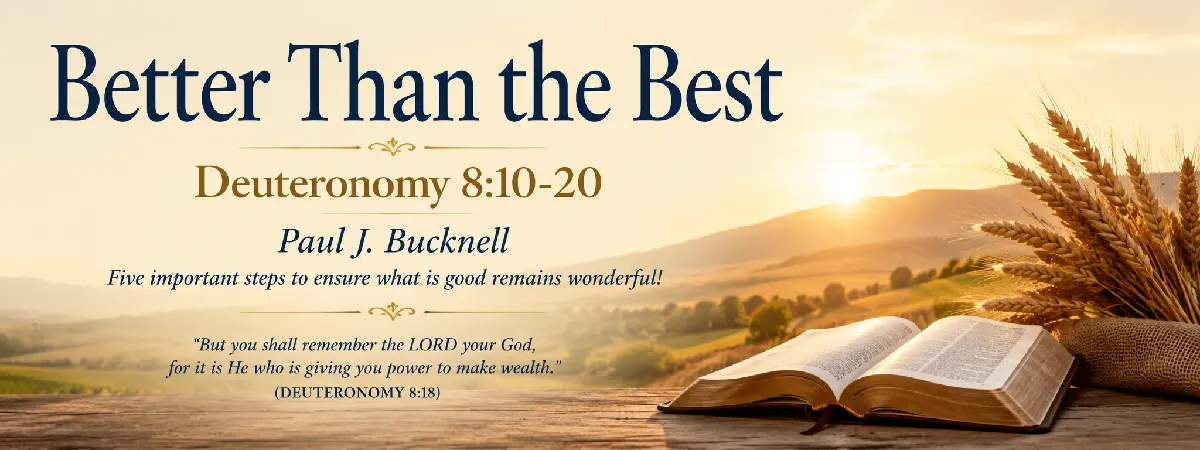
Deuteronomy 8:10-20 Better Than the Best
Prosperity can quietly pull God’s people away from the Lord, and Deuteronomy 8 offers five spiritual safeguards—gratitude, obedience, humility, dependence, and generous stewardship—to enjoy God’s good gifts without making them into idols.
“But you shall remember the LORD your God, for it is He who is giving you power to make wealth.” (Deut 8:18, NASB)
A recent article in the newspaper gives us an impressionable picture of the tug-and-pull of possessions in all our lives.
Beanie Brouhaha
A Las Vegas judge settled a divorced couple's argument over their Beanie Baby collection by ordering them to divide the stuffed animals one by one in the courtroom. As spectators in the gallery snickered, Frances Mountain and her ex-husband crouched on the courtroom floor among piles of the popular plush toys to split the collection, worth more than US$2,500. Ms. Mountain called it ridiculous and embarrassing. But clearly, King Solomon would have approved.
What makes this story so interesting is that, even though they disliked the embarrassment of choosing the next Beanie Baby, they still decided to go ahead with it. Sometimes, we're unaware of how much our love for possessions influences our relationships and life choices. Even in the middle of the courtroom, this couple couldn't see that the once bride and groom, who loved each other deeply, are now arguing over beanies. Possessions have taken precedence over relationships. Who wins? No one. Everyone loses.
In this case, what is considered bad? Are the Beanie Babies bad? Or are the things themselves bad? Certainly, there are negative things in life. We can easily recognize hatred, violence, selfishness, pornographic images, and so on, but I am focusing on the good aspects of life. We don’t say that good things are bad because they are good. For example, a vacation in Hawaii, a nice round of golf, a comfortable sofa, a digital television, or a big meal at a buffet — the list could go on. These things are good. In fact, we have been so blessed that the list may never end. Don’t you agree we have been greatly blessed?
But since these blessings, comforts, and joys are good, can they also be bad? If they have the potential to sour our lives, can we find a way to protect ourselves? That is our task today: to safeguard and preserve our great blessings. Let’s look at the five ways the Lord spoke through Moses to the Israelites long ago, before they entered the Land of Promise. Let’s examine them now.
1. Giving Thanks to God (Deuteronomy 8:10)
Not every society or generation has achieved the high standard of living we have today. When Americans talk about the poor, they often include those earning over $10,000 a year. Compared to many societies, this is considered wealthy. But I’d like to set aside the topic of income and focus instead on lifestyle. Measuring tangible goods helps us better compare the quality of life. I’ve read, and I believe many of you have read, numerous articles comparing the past and the present. There’s no easier way to gain a new appreciation for life than when we compare our gains with theirs. Someone once said that the average modern person lives in greater comfort than kings and queens of the past. I agree. But I think it’s also interesting to consider not only what comforts we have now, but, by God’s grace, what we will have in the future. The Post Gazette wrote,
“In 50 years, people will reflect on what we’re doing now, and call us barbarians... We’ll essentially be able to go shopping for a whole new array of artificial body parts, as well as organs - the blind will see with artificial eyes and the deaf hear with artificial ears... Genetic engineering will result in new body parts.”
Need a root canal? One appointment in the dentist’s chair, and the work will be finished—aimlessly. That is, if root canals are even necessary at all. Soon, dentists hope they’ll be able to implant a piece of bone that will simply grow into a new tooth. ... Vaccines will reduce the number of cavities and periodontal disease...
We could go on and on. But you know, and I know, that if things continue as they are, God has given us such creative powers that we can raise our level of comfort even more. But if this is true—that what is good can turn bad—then perhaps what is very good can become very bad. What is God’s first advice in protecting what we have? He says this in Deuteronomy 8:10.
“When you have eaten and are satisfied, you shall bless the LORD your God for the good land which He has given you.”
The first line of protection is expressing gratitude. There are several small steps we need to watch for. Let me quickly review them.
1) We are blessed. I have just listed several items and situations. Only a century ago, my wife and I would have spent a lot of time and suffering facing the harsh reality that half of my children would have died by age 12. Today, many of us might feel bored, but it's not because we lack blessings. It’s because we don’t realize how precious it is to live in this time and place.
2) God is the source of all good blessings. No matter how many great achievements man makes, God still gives the blessings. We may need to think more deeply to be convinced that our achievements are solely due to His grace. This isn't too hard either. For example, as much as doctors can help our bodies, it is the body that God has given and sustains that provides life and health. Doctors can only help create good conditions. Doctors are God’s helpers. God is the ultimate giver of blessings.
3) We shall ‘bless the LORD your God....” We need to step out and genuinely bless the Lord. Blessing means to speak forth what is right and good. We are not creating new religious ideas but sharing truthful observations. The Lord is blessed. We can sing the blessing, speak it out, or even write about His blessings, but the blessing must be our act. Do you agree?
2) Don’t forget and disobey God (8:11)
The first method of protection makes a lot of sense. We give thanks. The second one might be a bit confusing. Deuteronomy 8:11 says,
“Beware lest you forget the LORD your God by not keeping His commandments and His ordinances and His statutes which I am commanding you today.”
We are warned not to forget the Lord. There are two aspects here, and both are important.
The first is a warning not to forget God. If God has given us these blessings, then we should respond with faith and thank Him. We can think of a father who goes out of his way to give his children many gifts. If they take his kindness for granted, the father might forget their needs. They have their gifts, their college payments, their cars, and their toys—who cares how they got them? But truly, we must remember that the Giver is more important than the gifts. The gifts will fade, but the Giver is eternal.
Secondly, we must be fully aware that one main way to tell if we have forgotten God is whether we still value His Word. If we value His Word, then we will obey Him. If not, we will disobey. I know some believe it is not important to literally obey the Lord. They might make exceptions for lying, stealing, and not being kind. But you need to realize that when we stop genuinely loving one another, it shows we've started to drift away from the Lord. When we trivialize the importance of obeying all His commandments, we are beginning to walk away from God.
Application
It is important that we maintain a clear conscience. If we want to value our blessings, then we must value God Himself. We show respect by obeying Him; we show disrespect by disobeying Him.
3) Remember our humble roots (Deut 8:12-16)
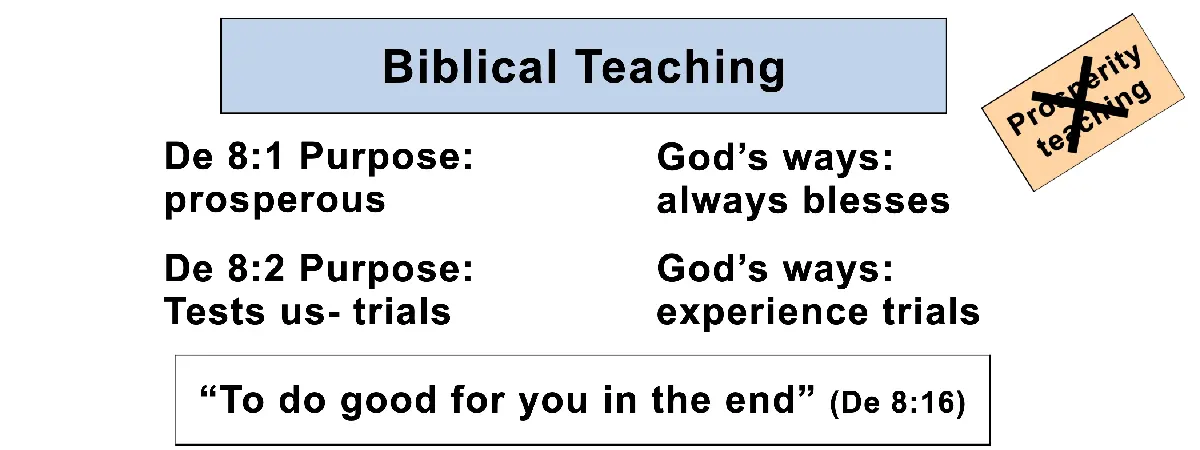
12 lest, when you have eaten and are satisfied, and have built good houses and lived in them, 13 and when your herds and your flocks multiply, and your silver and gold multiply, and all that you have multiplies, 14 then your heart becomes proud, and you forget the LORD your God who brought you out from the land of Egypt, out of the house of slavery. 15 "He led you through the great and terrible wilderness, with its fiery serpents and scorpions and thirsty ground where there was no water; He brought water for you out of the rock of flint. 16 "In the wilderness He fed you manna which your fathers did not know, that He might humble you and that He might test you, to do good for you in the end. (Deuteronomy 8:12-16, NASB).
The next step to preserve the joy of what God has given us is to remember where the Lord has brought us from. For the Israelites, they could always look back and see where they would have been if God had left them as slaves in Egypt. They could recall the miraculous ways the Lord led them out of the “great and terrible wilderness, with its fiery serpents and scorpions and thirsty ground where there was no water.” Even at the end, it is said, “He fed you manna which your fathers did not know, that He might humble you and that He might test you, to do good for you in the end.” Let’s review how people tend to drift away from God.
1) Filled with a good life.
• Eaten and satisfied
• Built good houses and lived in them
• Graduate, get a job, and be able to regularly generate income (herds and flocks multiply)
• Promotions (silver and gold multiply)
• Retirement benefits and bonuses (all that you have multiplied)
2) Become Proud
The heart becomes proud when we value what we have more than who we are—God’s children.
3) Forgot the Lord who saved you.
The key here is to remember our roots—what God has done for us by adopting us as His children. Where would we be without Him? If we forget our desperate ways before knowing the Lord, we might not think much about salvation itself. We could begin to think, “Who needs a Savior,” and start to esteem ourselves while neglecting our Lord. If we’ve stopped enjoying communion or quiet times with Him, it’s likely we haven’t thought much about our salvation lately. So, how do we truly think about our salvation?
• Reflect on your life before you knew the Lord. Remember the struggles you faced that God used to bring you to Him.
• Review your written testimony. If you don’t have one, take a moment to write it out.
• Quietly pause and think about that time in your life. For me, I had forgotten almost everything from those days until I thought of my salvation, and then I began to remember the changes He brought into my life. The difference is life and death, sickness and health, selfishness and love, sadness and joy.
4) Beware of self-confidence (8:17)
‘my power and strength’
We need to move on to the fourth step in keeping good things wonderful. The Lord has carefully guided each step so we can closely examine our hearts. You might ask, why must we return to our roots? The Lord answers this in the next verse, Deuteronomy 8:17.
“Otherwise, you may say in your heart, 'My power and the strength of my hand made me this wealth.”
If we do not humble our hearts by remembering where the Lord has brought us, we will start to believe that our own power and strength have brought us to and sustained our success. As you enter the stock market, you tremble and pray. When it grows, you sit back and admire your skills. When you apply for a job, you tremble, hoping to stumble upon the right words. You pray desperately. You have had the job for a couple of years, and then you begin to complain: not enough pay, a bad boss, and no sufficient promotion. Our roots often remind us of how we first sought the Lord. Without renewing our minds, we tend to deceive ourselves into thinking possessions reflect our own insight and effort. Then we feel the need to show off and prove to others how great we are.
Application
Do you find yourself wanting to brag about your wealth, purchases, investments, job promotion, or do you humbly thank the Lord and tell others how God has helped you yet again?
5) Remember the LORD (8:18)
‘He who is giving you power to make wealth.’
The last suggestion is a strong reminder that blessings and wealth are not due to us, but because of Him. Deuteronomy 8:18 says,
“But you shall remember the LORD your God, for it is He who is giving you power to make wealth, that He may confirm His covenant which He swore to your fathers, as it is this day.”
Two significant truths here:
1) God is the wealth maker. This has a number of developed thoughts.
• We should not be busy chasing money, but instead work diligently for our livelihood. The Scriptures are full of advice against pursuing wealth. Too many people have sacrificed their children, youth, families, friends, and even spouses in the pursuit of wealth. We must not neglect our responsibilities in order to gain riches. I Timothy 6:17-19 states,
“Instruct those who are rich in this present world not to be conceited or to fix their hope on the uncertainty of riches, but on God, who richly supplies us with all things to enjoy. 18* [Instruct them] to do good, to be rich in good works, to be generous and ready to share, 19* storing up for themselves the treasure of a good foundation for the future, so that they may take hold of that which is life indeed.”
• If God wants me to be rich, then He will make me rich. If He wants me to be poor, then I will be poor. I can be happy in whatever circumstances He sets for me. If you think this is ignoble thinking, just remember our Savior, Jesus, who was impoverished yet greatly blessed.
• Riches are best viewed as a gift from God rather than the answer to my life’s problems. The more riches there are, the greater the responsibility to use them to fulfill His great mission. The larger the amount, the easier it is to forget God and fall into serious sin.
2) God’s blessings are usually because of God’s faithfulness to others.
It is humbling to realize this, but once again, God’s Word proves true. Verse 18 says, for it is He who gives you the power to acquire wealth, so that He may confirm His covenant which He swore to your ancestors, as it is this day. We are wealthy because others have been faithful. If a family’s members have gambled, drunk excessively, or spent recklessly, then by not following wise stewardship principles, the wealth leaves. Conversely, how many of us have been blessed by our parents’ wealth? Certainly, wealth can be passed down. You might not appreciate this if you're young and come from an affluent family, but consider living in a rundown house with broken windows, rats in the basement, broken and leaky pipes, and parents who don’t care. When we live according to God’s principles, His blessings are stored up for us. Many of our blessings come from His faithfulness to others.
Summary warning (19-20)
“And it shall come about if you ever forget the LORD your God, and go after other gods and serve them and worship them, I testify against you today that you shall surely perish. Like the nations that the LORD makes to perish before you, so you shall perish; because you would not listen to the voice of the LORD your God.”
If our hearts turn to other gods, then God will treat us like the nations that perish due to disobedience. We will see God’s judgment among His professing people, reflecting what happens in society. God is saying that if our hearts follow other gods, we will suffer like those who are not His people. Moses ends with a warning because this problem is serious. When we forget God, we live like the nations. When we stop living by His principles, we will suffer alongside the nations. What makes us different as Christians is our faith and lifestyle. If these are lost, God will simply put us in the other category because that’s what we are.
Summary applications
I want to share several applications for our lives. This message contains so much. We've seen that drifting away from God into materialism isn't new. However, despite our wealth, we often struggle to remain committed to God.
1) Don’t chase after wealth or seek quick schemes to get rich. Scripture warns us against this. There are serious consequences when we prioritize wealth and luxury lifestyles as our purpose.
2) Remain faithful to the Lord in all financial matters. As He blesses you, give accordingly. The scriptures tell us to bless the Lord, and giving to Him is one of the best ways to do so. I’ve told you before that giving a tithe might seem insufficient considering our wealth. You might feel like you're just getting by, but often we accept a certain level of riches that makes generous giving hard. Last year, I shared how we should give more proportionally. If God multiplies our blessings, we should multiply our thanks.
The real question is: how will we stay close to God? How will we keep these blessings good and prevent them from becoming stumbling blocks?
•My only solution is that we give more and more, making ourselves mindful that only what we give in thanks we will keep forever.
• Only by increasing our giving can we avoid getting carried away with storing up wealth.
• Only by stretching our faith can we, along with our families, focus on Him rather than what we have.
• Only by giving more even when in need can we establish that He is the maker of wealth.
• Only by proportionally increasing our giving do we affirm that He has made us priests to the world with a mission to accomplish. If He has given us wealth, then we need to use it to accomplish His purposes.
We didn’t meet our budget last year. This is the first time I remember us not reaching the general budget since I’ve been here. We have started a building fund. I encourage you again to review your income and reflect on how much you are really giving. People ask whether it is before taxes, or one tithes (giving 10% to the Lord). Yes. Young people ask how they can give if they don’t work. Don’t give from your parents’ school or book payments, but if you receive an allowance, definitely learn early to give at least 10%, and hopefully more as your faith grows. Pick your own missionary to support.
I tell my children that the thousands we give each year could buy us a better car, a better vacation, bigger and better toys, but these don’t last. In fact, we know from the scriptures that my family would soon leave the Lord if I couldn’t celebrate giving. I, in fact, would leave the Lord. Instead, we get to see exciting answers to prayers. We get to invest in the world beyond. We get to honor our Lord. I am no longer even tempted to give less. The blessings are so overwhelming. I have set my household on the path of keeping what is good and making good for eternity. How about you? Your family?
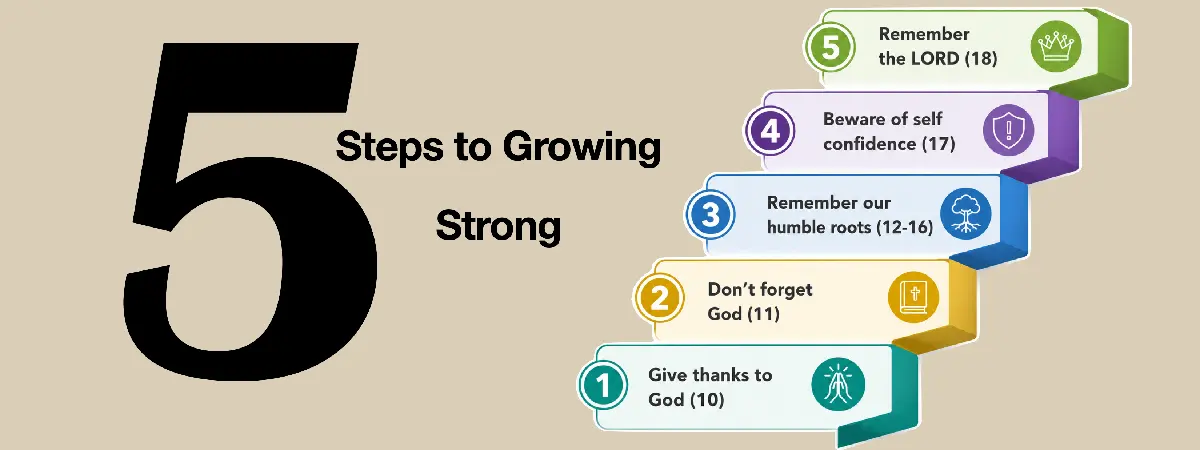
We have 5 steps to keep what is good, wonderful.
1. Giving Thanks to God (8:10)
2. Don’t forget God (8:11)
3. Remember our humble roots (8:12-16)
4. Beware of self-confidence (8:17)
5. Remember the Lord (8:18)
The Lord is not there to take away our joys but to ensure them. He cares enough to teach us how we might drift away from Him so that we can catch our wandering hearts and return to His ways. The Lord wants us to live beyond the worries of the world. Where are you today? Have you left Him? Please come back and rediscover His blessings once more.
Deuteronomy 8 Bible Study Questions
1. Why does Deuteronomy 8:10 connect satisfaction with blessing the Lord?
2. How does disobedience reveal that a person is beginning to forget God?
3. What “humble roots” has the Lord brought you from, and how can remembering them protect you from pride?
4. Where are you most tempted to say, “My power and the strength of my hand made me this wealth”?
5. How should Christians understand the phrase, “He is giving you power to make wealth” in Deuteronomy 8:18?
6. What good gifts in your life are most likely to become spiritual distractions if left unguarded?
7. What practical step of thanksgiving, obedience, or generous giving would help you remember the Lord this week?