Written by Paul J Bucknell on May, 26, 2026
Deuteronomy 31 Life’s Calling and Faith
God gives each believer a life to steward, a calling to embrace, and His own power to move forward by faith.
Deuteronomy 31-32 urges us to redeem our time by better understanding our calling and moving forward in faith to seize the opportunities to accomplish all that God has designed for our lives. These chapters bring us to the summit where two great events from two great eras of two remarkable people come together. Moses depicts the passing of the past, while Joshua signifies the beginning of a new era—the crossing of the Jordan into the Promised Land.
Our approach
Perhaps I should start by explaining that this study doesn’t focus on Deuteronomy 32 or the theme of God’s people drifting away from the Lord.
“And the LORD said to Moses, “Behold, you are about to lie down with your fathers; and this people will arise and play the harlot with the strange gods of the land, into the midst of which they are going, and will forsake Me and break My covenant which I have made with them. “Then My anger will be kindled against them in that day, and I will forsake them and hide My face from them, and they shall be consumed, and many evils and troubles shall come upon them; so that they will say in that day, ‘Is it not because our God is not among us that these evils have come upon us?’” (Deuteronomy 31:16-17).
Please understand that neglecting this theme doesn’t mean it’s unimportant. Just like the Israelites of old, the church tends to drift away from the Lord. Time and again, we see the church straying from its love for Christ, pure doctrine, and holy living. This warning carefully placed at the end of the Book of Deuteronomy must be studied carefully and followed closely. I believe it deserves proper attention. However, in this article, we take a different approach. Instead of focusing on the warning itself, we concentrate on the solution for a wayward heart. This is the first thing the Lord shows us to meditate on in the 31st chapter of Deuteronomy. He offers us insight on how to live our lives for His glory so we do not fall into ruin.
Focusing on God’s will
These closing chapters of Deuteronomy are very instructive and helpful for each of our lives as individuals and as a corporate group. If we look closely, we will find a confluence of events that can tremendously help clarify our life goals and purpose.
It makes me think of my young days when I braved the cold New England waters north of Boston. On the best of days during high tide, big waves would rush in toward the shore, and in some places, because there was a sea wall, they would bounce off and move back out to sea. I know where I would be - right in the middle of those two waves when they met.
They would momentarily form a powerful upward surge, lifting me high before splitting and going their own ways. No one would expect those two waves to stay together. They were heading in different directions. But for a brief moment, they moved as one.
Deuteronomy 31-32 is much like this upward surge. Two great waves heading in separate directions, yet in this passage, they are united through a special moment. The ocean waves physically push upward, but these two movements together offer deep insight into our lives. They are far more significant to us.
The experiences and words from God recorded here help clarify our life’s purpose and strengthen our resolve to pursue it. In a brief moment, we can glimpse what we are living for and gain insight into our level of commitment to do what we were created for. These profound insights are captured here as we reflect on these chapters. They are soul-searching moments, and such discoveries can cause us to soar high in our spirits with many lasting benefits.
Prayer
Dear Lord, open our hearts to the magnificent and wonderful work you want to do in each of our lives. We have so stereotyped you that your will has become unappealing and boring in light of what the world says. Lord, take the glory of your truths captured in these chapters, shatter the false promises of the world, and draw us into a deeper commitment to what you have designed us for. In Christ’s Name we pray. Amen.
Outline
The Book of Deuteronomy is coming to an end. Preparation for the future is essential. Moses will leave this world, and Joshua will take over leadership, guiding the Israelites across the Jordan River into the Promised Land. The Lord is not only ushering the Israelites into a new era but also challenging us to make the most of our days and to redeem the time, for the days are evil.
If you like, draw your own map and consider what the Lord is saying to you. Now, let us turn our attention to these two powerful movements that intersect here in Deuteronomy 31.
A.) Affirm Our Calling - Moses (Deut 31:1-2; 32:48-52)
#1 Awareness: Being aware of our new task, its challenges, and requirements.
B.) Joshua: Moving Forward (Deut 31:3-30)
#2 Acceptance: Embracing what we need to do.
A.) Affirm Our Calling - Moses (Deut 31:1-2; 32:48-52)
What does God have for my life?
Wisdom is more easily found among the elderly than the young. The reason is simply that they have gained many more insights, forming a broader perspective than the young. However, this wisdom from age is of little help. We need to acquire wisdom early to better shape our lives now before making our colossal mistakes. Hopefully, this is what we can find here in this discussion.
This is our chance to gain a better perspective on life through reflecting on Moses’ life. His final days are depicted here. He died at 120 and has experienced more than us. The end of his life has come. Even though he saw, heard, and met with God regularly, his life on earth has ended.
“So Moses went and spoke these words to all Israel. And he said to them, “I am a hundred and twenty years old today; I am no longer able to come and go, and the LORD has said to me, ‘You shall not cross this Jordan.” (Deuteronomy 31:1-2).
This was a pivotal moment in Moses’ life. Unlike the Book of Numbers, where the Israelites kept moving, in Deuteronomy they stood still, waiting for final orders, instructions, and the renewal of the covenant before crossing the Jordan and reaching the Promised Land. Moses’ life would conclude here. We aren’t certain whether the “today” refers to that specific day, perhaps his birthday, or if it was the year he turned 120. Most likely, the latter. The issue remains the same—he could no longer move forward. His days were coming to an end. He would soon climb the mountain and never come down. He couldn’t go on.
1) Gaining a whole perspective
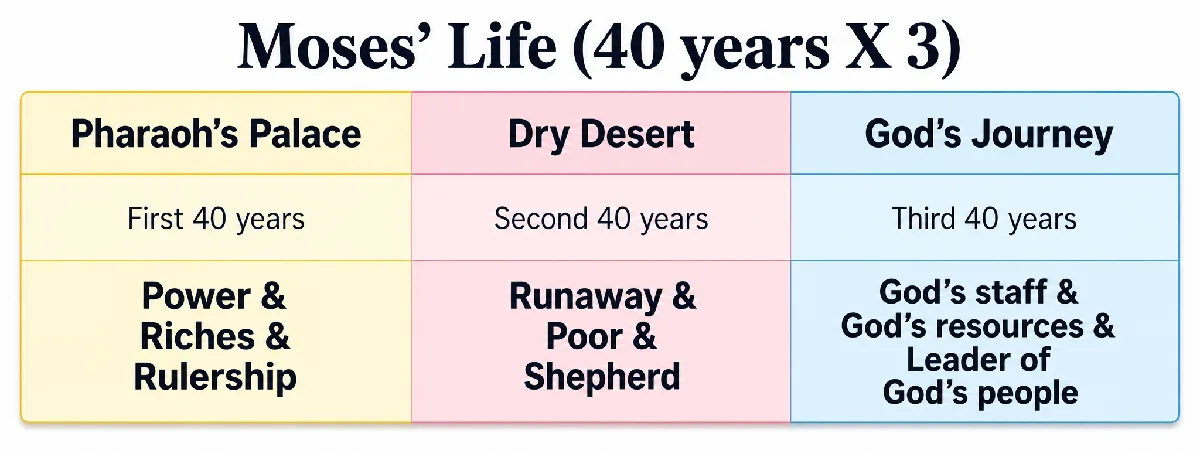
Moses was an incredible individual with an astonishing background. He wasn’t always brave and wise. His early life was nearly ended when Pharaoh ordered the killing of male Hebrew babies in Egypt. God miraculously saved him. Moses foolishly killed someone to protect another from harm. He had to run for his life at the age of 40. Moses’ life can be easily divided into different phases.
- 40 years in Egypt - prince
- 40 years in wilderness - shepherding
- 40 years in the wilderness - leading God’s people.
Moses’ life had a mixed record. Moses was afraid to speak God’s Word, so the Lord appointed his brother Aaron to speak for him. It was through Moses that the ten plagues were brought upon Egypt, which impressed the world’s most powerful nation enough to force them to free the Hebrew slaves. Moses stayed in God’s presence for forty days on the mountain with Him. The same Moses pleaded to take his own life if Yahweh God would kill all the people. God refused to kill Moses and saved the people. This is the same Moses here east of the Jordan River at 120 years old. God told him that he could not cross over. By climbing the mountain as God instructed, he would go and die.
Application
Each of us will face our final day, though we do not know when; God determines it. For my cousin’s wife, it came unexpectedly—one day, the busy wife and mother was suddenly gone. Whether early or late, we all face a day of accountability and are asked the searching question, “What have you done with your life?” While this question may seem confusing at first, it becomes clear when we understand His good purpose for our lives. We will explore this further in the second half of the message.
Each of our lives is unique, like Moses’s. It is crucial that we see our lives from God’s perspective. Moses did this when he stepped aside to observe the burning bush. Similarly, God is calling us to turn away from ordinary living and to begin discovering the purposes for which He created us. The world dismisses any such meaning in life, preferring us to focus on experiences. However, we learn God’s purposes for our lives when we view our lives with a long-term perspective.
God’s design for our lives indicates a special purpose and provides many opportunities to reflect His glory through our individual choices. Don’t wait until the end to pursue those things. God has a unique plan for each of us. We must recognize His specific purpose or calling early on. It’s tragic to only realize it at the end of our lives!
If it’s only at the end, it shows we did not value Him and His purposes. Instead, we served ourselves rather than Him. We never experienced the joy of seeing Him accomplish His great will. The time will come when we can do nothing else on earth. Make the decision now to wholeheartedly seek His will in your life. Today can mark the beginning of the rest of your life.
2) Evaluate one’s life (Deuteronomy 32:48-52)
“And the LORD spoke to Moses that very same day, saying, “Go up to this mountain of the Abarim, Mount Nebo, which is in the land of Moab opposite Jericho, and look at the land of Canaan, which I am giving to the sons of Israel for a possession. “Then die on the mountain where you ascend, and be gathered to your people, as Aaron your brother died on Mount Hor and was gathered to his people, because you broke faith with Me in the midst of the sons of Israel at the waters of Meribah-kadesh, in the wilderness of Zin, because you did not treat Me as holy in the midst of the sons of Israel. “For you shall see the land at a distance, but you shall not go there, into the land which I am giving the sons of Israel.”” (Deuteronomy 32:48-52).
God not only gives us life to live right lives but also assigns us tasks. Admittedly, we cannot accomplish these without His grace. Consider Moses for a moment. Even under the curse of the Law, we see God coming to his aid when he fights east of the Jordan River. Moses had his own unique context and calling, and so do we. Whether you’re a prince in court, a shepherd in the field, or a prophet serving God, remember that God has given each of us our own time to live, language, features, livelihood, and calling. Moses seemed to carry a burden in his heart that grew over time. He was deeply aware of the Israelites’ need to be freed from their oppressors. Moses tried to help by killing one guard, but that was not God’s way. For many years, he appeared to be a runaway from God.
“Take the rod; and you and your brother Aaron assemble the congregation and speak to the rock before their eyes, that it may yield its water. ...And Moses said to them, “Listen now, you rebels; shall we bring forth water for you out of this rock?” Then Moses lifted up his hand and struck the rock twice with his rod; and water came forth abundantly, and the congregation and their beasts drank. But the LORD said to Moses and Aaron, “Because you have not believed Me, to treat Me as holy in the sight of the sons of Israel, therefore you shall not bring this assembly into the land which I have given them.” (Numbers 20:8-12).
The point here is that God holds us accountable for what He has called us to do. When we fail, there are consequences. We see this in the passage above. Notice the two times ‘because’ is used in the text. God very clearly held Moses accountable for his own actions. God told Moses to speak to the rock, but Moses struck the rock. It was for this reason that the Lord did not allow Moses to enter the land. Life could have been different.
Moses’ life could have gone on, but because of his rebellious act, his life ended. We need to see how our decisions always affect our lives and those of others. Many of us mistakenly seek God’s will. I’ll admit it sounds noble to seek God’s will. “Oh, Lord, help me go to the right college.” Or “Lord, please help me find the right job.” Indeed, we all need to know God’s will for these choices, but often we ask the wrong question.
We often turn to the Lord for the ‘big’ decisions because we know they affect our lives. Our motives aren’t always right; we seek what benefits us most. If God can help with that, we should ask for His advice. The problem is, we don’t have clear intentions to serve Him; we just want His blessing. This attitude is what causes God’s people, generation after generation, to drift away from Him. Has it affected your life too?
Good decisions can only be made when our entire lives are dedicated to Him. We cannot earn His blessing with just one prayer. We need to actively seek Him and His will, not just focus on our own welfare.
“But seek first His kingdom and His righteousness; and all these things shall be added to you” (Matthew 6:33).
We should seek Him, not just His favor at a certain moment. Let me share a better way to gain perspective on your entire life and to seek Him.
Think of God’s will for our lives as two parallel lines. Everything between these lines represents God’s will. Things that happen outside of them are not God’s will. By that, we mean that, although they fall within God’s permissible will (He allows them to happen), they are not the best choices we could make. For example, a believer might decide to marry an unbeliever. Clearly, this is not God’s will, but God permits the person to do it. See the diagram.
We need to view our lives as a whole and dedicate everything to the Lord. We’re not just saying we want certain parts of God’s will; we want everything God has planned for us. If we claim to want God’s will, then we should fully commit our lives to that purpose. If we believe God’s will is good and the best, we shouldn’t hold back any part of our lives as we seek Him. In this way, you and I will experience God’s full blessing.
Our calling is closely related to the gifts and burdens He gives us, but it also significantly involves the context of our lives: our marriage, parenting responsibilities, our work, and serving in the church and elsewhere. All of these are connected to God’s greater purpose for our lives.
Our calling
The clearer our understanding of our calling, the better. It is only our vision of what God aims to accomplish through our lives that motivates us, guides us in making wise decisions, sustains us during tough times, and fosters gratitude instead of pride. This vision makes a profound difference in our lives. God expands, directs, and narrows that vision as life unfolds. We need to adapt, just as Moses did during different stages of his life.
There are many calls to mediocrity–just getting by. Mediocrity means losing sight of what God has planned for our lives. Instead, we become consumed with our own desires and passions. The life of mediocrity tells us to work to survive, while God calls us to live for His work. Jesus said,
“Do not work for the food which perishes, but for the food which endures to eternal life, which the Son of Man shall give to you, for on Him the Father, even God, has set His seal.” (John 6:27).
What will it take for you to ask and discover what God has planned for you? I don’t mean which church to attend or what college to choose. These are superficial questions if you haven’t committed your whole life to the Lord. We need to live our lives in light of God’s grand vision for us.
One day, we will look back and realize that some of what we have done has been burned away because it was built on temporary things, those that burn.
“Now if any man builds upon the foundation with gold, silver, precious stones, wood, hay, straw, each man’s work will become evident; for the day will show it, because it is to be revealed with fire; and the fire itself will test the quality of each man’s work. If any man’s work which he has built upon it remains, he shall receive a reward” (1 Corinthians 3:12-14).
Unless you work on your marriage, family, work, and spiritual service with God, everything else will be burnt up. It will matter little whether you have a Ph.D. behind your name or if you live so poorly that you have no grave or tomb. Only those things gained through His strength, done with His wisdom, and built on faith in God will earn eternal rewards.
Summary
We must seize this moment and take advantage of the present. From Moses’ life, we learn our first valuable lesson—a perspective on life. We will be judged on how we manage our lives, both as a whole and through individual choices. We become wise if, amid our lives, we seriously evaluate ourselves and dedicate the rest to Him. Right now, each of us can change our course. We can focus on what matters most.
Theological Symbolism
We need to recognize the text’s theological symbolism. Moses represents the Law, the Old Covenant. Joshua, whose name means “Jesus,” symbolizes the New Covenant.
Moses’ inability to enter the Promised Land is a symbolic reminder that the Law, as outlined in Deuteronomy, was never meant to give eternal life. Moses could not enter because of his sin, clearly showing that even Moses could not fulfill the Law. He needed Joshua (Jesus) to lead him there. Let me share two points from this. Don’t misunderstand me. I am not encouraging anyone to do less than they should. But we should humble ourselves and acknowledge that no matter how many good works we do, they are not enough to bring us into the presence of our holy God.
“Then die on the mountain where you ascend, and be gathered to your people, as Aaron your brother died on Mount Hor and was gathered to his people, because you broke faith with Me in the midst of the sons of Israel at the waters of Meribah-kadesh, in the wilderness of Zin, because you did not treat Me as holy in the midst of the sons of Israel” (Deuteronomy 32:50-51).
The word ‘die’ is so final—a command! Go and die. But it marked the last words given to Moses. The reason is clear: he broke faith with the Lord in the midst of the sons of Israel.
“Now we know that whatever the Law says, it speaks to those who are under the Law, that every mouth may be closed, and all the world may become accountable to God” (Romans 3:19).
The point is very obvious, but after years and years, we still struggle to understand it and quickly forget it. We believe that we earn our righteousness through our good deeds. Our confidence in eternal life wrongly depends on a few actions like attending church, giving an offering, or trying hard not to. sin.
But whether you are raised on the Law or have your own internal law embedded in your conscience, we are all like Moses. We still will utterly fall short of that standard. We fail to meet God’s perfect standard. That old but insightful short verse captures this for us: “For all have sinned and fall short of the glory of God” (Romans 3:23). May it not stand over any of our graves in a condemning way. Have you failed in one area? That is it. It might sound cruel, but the Law does not allow exceptions.
If you spend your life trying to impress God or build up your good works, it will not work. Moses represents the Old Covenant. The Law would not even bring the ‘friend of God’ over the Jordan. Neither can it help us in this most important way. Only Jesus (Joshua) can do this for us.
Application
Accept your incompleteness without Christ. Recognize that you could never truly please God on your own. The Law cannot lead you into the Promised Land. As mentioned, no matter what good you do, it will never be enough. We have failed to live a righteous life and must face death. However, there is another way to cross that river of death. We must let Jesus (Joshua) lead us. Are you committed to Christ Jesus for forgiveness of sin and eternal salvation?
B.) Strengthen Our Faith - Joshua (Deut 31:3-30)
How can I accomplish such things?
“It is the LORD your God who will cross ahead of you; He will destroy these nations before you, and you shall dispossess them. Joshua is the one who will cross ahead of you, just as the LORD has spoken. “And the LORD will do to them just as He did to Sihon and Og, the kings of the Amorites, and to their land, when He destroyed them. “And the LORD will deliver them up before you, and you shall do to them according to all the commandments which I have commanded you. “Be strong and courageous, do not be afraid or tremble at them, for the LORD your God is the one who goes with you. He will not fail you or forsake you.” Then Moses called to Joshua and said to him in the sight of all Israel, “Be strong and courageous, for you shall go with this people into the land which the LORD has sworn to their fathers to give them, and you shall give it to them as an inheritance. “And the LORD is the one who goes ahead of you; He will be with you. He will not fail you or forsake you. Do not fear, or be dismayed.” (Deuteronomy 31:3-8).
What we discover when we carefully examine Deuteronomy 31 is that the Lord is transferring leadership and anointing to Joshua. If we only look superficially at these passages, we will miss the main message. Just as in verse 2, the Lord told Moses that he would not cross over, so it was the Lord, Yahweh, His Name, who will “cross ahead of you; He will destroy these nations before you.”
#1 The Lord is in charge (Deut 31:1)
The Lord has always been in charge, then and now. No matter how much secularists try to erase the Lord’s Name from history, science, and nature, God remains entirely involved in this world. We have been so brainwashed that some of us repeat the modern mantra, “There is no God.” However, the opposite is true.
Yahweh has a mission and is fulfilling it today. You might see church buildings now used as museums or pubs, but that is a fitting end for those who have abandoned the Living God for their humanistic, death-seeking religions. But please do not dwell on these sights as signs of God’s judgment—those belong to the first point. Instead, journey with me now to India, Russia, Cuba, Africa, and China. There, you will witness the very end-times being reached for Christ. Millions are coming to the Lord, filled with zeal and love.
They have rejected what the world offers and taken up their cross. God is guiding millions forward. Can you hear the trumpet sound? Or are your ears blocked by EarPods filled with worldly music? Can you see the excitement of what God is doing around the world, or are your eyes caught up in feeding the frenzy of screens, watching the latest and greatest? I call you—if you truly belong to the Lord—to either stand for Him or leave Him. If you are for Him, do not get caught in worldly parties. The Lord needs soldiers who will obey His commands; they must be strong and capable. We who have extensive Bible knowledge are often weaker than those with only a fraction of what we know. What a shame!
#2 The Lord is all-powerful (Dt 31:1-8)
Although similar to the first point, the idea that the Lord is all-powerful is still quite different. A person might lead but not be able to help. God was not like this in this situation, nor is it true in ours. Notice what it says here:
- He will destroy these nations before you
- And the LORD will do to them just as He did to Sihon and Og, the kings of the Amorites, and to their land, when He destroyed them.
- And the LORD will deliver them up before you, and you shall do to them according to all the commandments which I have commanded you. “Be strong and courageous, do not be afraid or tremble at them,
- The LORD your God is the one who goes with you. He will not fail you
- The LORD is the one who goes ahead of you… He will not fail you or forsake you.
The point is that the battle isn’t about whether they can fight harder or stronger than the enemy. God has already taken care of those issues. His people only need to work alongside Him. Let’s simply interpret this into practical theology.
The combination of the first two truths means that the Lord will reveal His will, and no matter what that will involves—how difficult, demanding patience, resources, knowledge, or strength—none of these factors will prevent God’s ministry from moving forward.
I used to think about how, if my ministry or family had more money, I could... I then realized that money, personnel, etc., are never the real problem. God will ensure His will is done if I work with Him. This brought me relief and also decreased the blame placed on God. God is not unfaithful; He carries out His will in His time. Moses began his ministry at 80 years old. Are you in such a hurry? God evidently put a burden on Moses’ heart to free his people from the oppressors many years earlier, even when he killed that guard. But God’s timing is perfect. So now, when I catch myself doubting God’s provision, I rebuke my spirit and thank Him for what we have. As the feeding of the 5000 shows us, provision is never the issue. God has all the power to accomplish what He desires. This is an important lesson for our next point, which is our part.
#3 God’s people need courage (Deut 31:6-8)
“Be strong and courageous, do not be afraid or tremble at them, for the LORD your God is the one who goes with you. He will not fail you or forsake you.”” Deut 31:6).
Do you see how these commands to gather courage and fight fear complement what has been said about God’s place in the first two points? If we could grasp these three points, many of our problems would pass. We would still face difficulties, do not get me wrong—just like Joshua still had enemies to confront. The Lord didn’t simply wipe out his enemies. It would have been easier without Joshua. That’s the point. God wants to work with us. He calls us to join Him in His work.
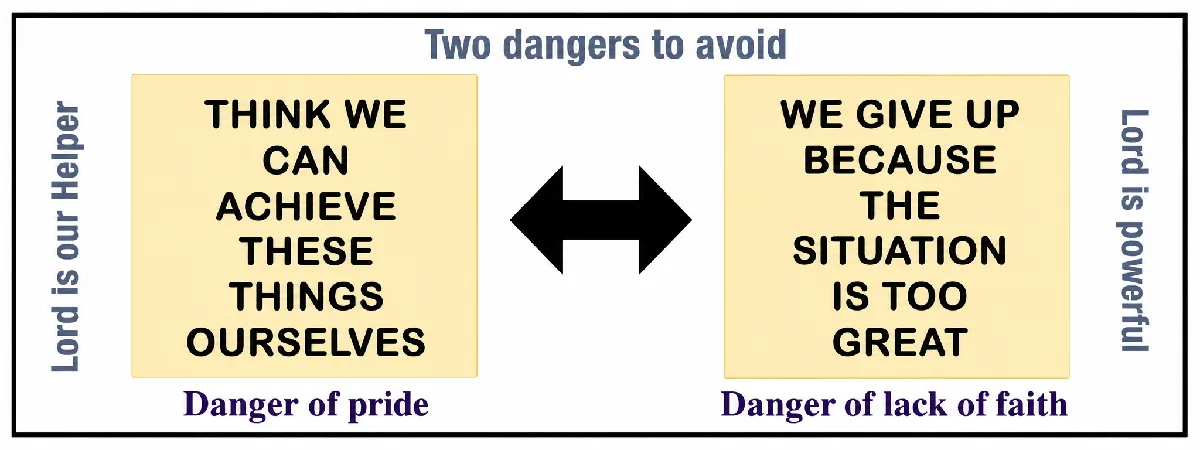
We cause problems when we (1) think we can achieve these things without Him or (2) give up because it’s too overwhelming. Through these commands, the Lord is providing a way for us to accomplish it. Think for a moment—have you taken on a task without relying on Him or just given up?
Joshua’s problem seems to be the second—giving up. At least, that’s what the commands to be “strong and courageous” and “do not be afraid or tremble” seem to indicate. Maybe more of us are like that. Or, when we think we can handle things on our own, we might respond like those who first attacked Ai—they ran away and said, “Oh, poor us.”
I don’t think we fully understand what our greatest battles are. We tend to miss this entirely. I’ll speak more on this when we conclude today. But as we start to understand what we need to do, we’ll need courage to face the fight. It’s not a time for fear, which is a major weapon of the evil one. Move forward. Keep going. Remember, it is the Lord’s fight, and you are simply joining Him in it. This is generally expressed in verse 6 and then specifically addressed to Joshua in verses 7-8. This is a general call to join the Lord in His work. We need to live our lives in line with God’s purposes. However, the Lord will specifically rally and encourage us personally when needed. This is true whether you’re a parent or a missionary. All of His work is holy.
Sometimes we want the Lord to speak to us directly. That is good. But He does not speak often—only when it is necessary. I say this not because the Lord does not speak regularly to us; He does through His Word and our daily times with Him. If you neglect that, then you neglect the means by which He would give extra wisdom and faith. But be sure, if you need more, then He will speak more. Just act on what He has already said and do not demand more from Him.
Often, we insist that God speak not because we want to know His will, but because we want sight instead of faith to guide us. More often than not, He has already spoken, but we have allowed sight to guide us. Do not think sight is more reliable. He wants to lead us by faith. If you are content there, then He can speak to us more freely.
Someone might rightly ask, “How do I get the strength and courage to move forward?” “I feel so helpless and defeated.” This feeling is more common in our lives than we like to admit.
#4 Know the Word of God (Deut 31:9-13)
There is no substitute for knowing God’s Word. If we are ministering to those without books or reading skills, we need to help them memorize God’s Word.
“So Moses wrote this law and gave it to the priests, the sons of Levi who carried the ark of the covenant of the LORD, and to all the elders of Israel. Then Moses commanded them, saying, “At the end of every seven years, at the time of the year of remission of debts, at the Feast of Booths, when all Israel comes to appear before the LORD your God at the place which He will choose, you shall read this law in front of all Israel in their hearing. “Assemble the people, the men and the women and children and the alien who is in your town, in order that they may hear and learn and fear the LORD your God, and be careful to observe all the words of this law. “And their children, who have not known, will hear and learn to fear the LORD your God, as long as you live on the land which you are about to cross the Jordan to possess.” (Deuteronomy 31:9-13).
The same is true. We all need to hear the Word of God. In these verses, we find that the people of God are regularly to hear the Word of God. We typically go from hearing God’s Word to thinking about what God says, then to not thinking of God’s Word, and finally to saying God does not speak.
#5 Transfers the Responsibility (Deut 31:14-23)
Sometimes, the lines of new responsibility are clear; sometimes, they are not so clear or dramatic. When a mother bears her first child, she is now a mother. The father becomes a father. The new role brings a whole new set of responsibilities. Joshua was commissioned in verse 23. He no doubt felt ill-equipped. This is why the words “Do not fear, be courageous” are repeated again and again in Joshua 1 and even mentioned here. He felt the burden of the new role, as if it were more than he could properly handle. I want you to know that the Lord often brings us to that point. That is okay and normal. It reminds us of the first point: God is leading and guaranteeing victory, not our own prowess. In this way, He gets the glory, and we are properly and humbly placed in His service.
I think about a conversation with a young couple. I asked about having children. He said he feels too immature. From what we studied here, what would you say to him?
First, we can tell him that he is right where God wants him. He is married, and that is the right place to have children. He should look forward to having children.
But you might wonder, what about all his fears of immaturity? Well, that’s okay. Faith often runs on empty. Faith doesn’t always see what’s needed. If we live only by sight, then we will never accomplish God’s work. The world bases everything on sight, especially with issues like this global warming. They fear that too many people will threaten their lives. They can’t believe that God will take care of our needs as He promises. So, they stop having children, and some even create organizations that force or trick others into sterilization. But the problem runs much deeper.
Application to Marriage
Let’s think about marriage. A couple marries with great hope and anticipation. Two months later, each person begins to wonder if they made the right choice. They start using the term ‘incompatible.’ By the way, if you are single, think about a close friend you’ve found, and then realize you might face some difficulties—what would you do?
You might feel upset. The person may not be acting responsibly. You might simply respond to them. And perhaps your spouse is acting so irresponsibly that you feel justified in giving your partner the cold shoulder. You have a choice: you can either dwell on what you see as wrong or take a leap of faith and live by it. God commands a husband to love his wife, regardless of her kindness, confusion, or wickedness. This belief helps a husband recognize that he might look foolish or out of control, but he desires more than anything that God’s love flows through his life into his wife’s. By faith, he understands that this is exactly what she needs—not the arrogant, violent push of words or fists—but kind, patient, firm, and tender words.
The wife needs to do the same. She is called to live by faith. The task, like Joshua’s, seems way beyond reality. Submit to that kind of husband? Lead a group like them? “You must be crazy.” But the Lord is absolutely serious. This is why the Christian life is a supernatural experience. We might think that leading the Israelites into the Promised Land is a supernatural act, but so is your marriage and, for that matter, any relationship. This is where Jesus said they would see Christ’s changing love through you and me. It is best seen in these impossible places where we can’t do it on our own. How you respond to people, in God’s way or yours, is a good test of your spiritual character—that is, how much you, as God’s child, allow the Spirit of God to work through your life. Getting married, having a child, gaining a brother, being in a family, having a roommate, discovering a neighbor, finding a job, standing up to someone on the bus, or driving next to someone on the highway—all involve roles that call for new responsibilities from us, whether in the short or long term. One could even evaluate their life and see where they notice God working or where He needs to be working more extensively.
Deuteronomy 31 Study Questions
- How does Moses’ final stage of life help you evaluate your own life from God’s perspective?
- What is the difference between seeking God’s help for a decision and dedicating your whole life to God’s will?
- Where are you most tempted to think you can accomplish God’s work in your own strength?
- Where are you most tempted to give up because the situation feels too great?
- How does the promise that the Lord goes ahead of His people strengthen courage and faith?
- Why is knowing and hearing God’s Word essential for moving forward in obedience?
- What new responsibility has God placed before you, and what would it look like to respond by faith rather than sight?