Written by Paul J Bucknell on May, 11, 2026
Numbers 7: 1-89 Dedicatory Offerings for the Tabernacle and Altar | The Bible Teaching Commentary
Numbers 7 highlights the joy of generous dedication before the Lord. Through the leaders’ equal offerings, the Levites’ support, and God’s voice from the mercy seat, we see that true giving serves worship, unity, and God’s kingdom purposes.
Moses anointed the tabernacle on the day it was set up (Num 7:1). The leaders of the twelve tribes brought their dedicatory offerings. This passage mentions two kinds of offerings in Numbers 7: dedication offerings for the tabernacle (verses 1-9) and those for the altar (verses 10-88). Since these were for the dedications, these offerings were not to be repeated upon their use. It’s interesting to examine the significance of their recording in the scriptures. Perhaps it hints at a sober celebration of these dedications, deepening our appreciation for the importance of the tabernacle and of worship itself.
Two special events were packed into that celebration. They were given willingly. Donations to charities have been declining recently, but much of this giving is driven by pride or tax benefits. (It reveals how many of us base our lives around the idol of money.) These opportunities in the church continue to reveal our contradictions about our faith and our commitments to the church. Let’s see how these two special offerings increased the excitement of that day—actually two weeks. We will explore five principles of volunteer giving.
This scene should immediately follow Exodus 40 and is associated with Leviticus 9, where wages are provided for Gershon and Merari. In Exodus 25, the Lord asked the people to make a freewill offering.
(1) Tabernacle Offerings (Numbers 7:1-9)
The Israelite leaders offered sacrifices after finishing the tabernacle. The Lord told them to give these to the Levites in a specific way. The tabernacle, as the full worship system, allowed God’s people to come and stay in His presence.
- Gershon: two carts and four oxen
- Merari: four carts and eight oxen
- Kohath: (received no gifts). “…because theirs was the service of the holy objects, which they carried on the shoulder” (Num 7:9).
“4 Then the Lord spoke to Moses, saying, 5 “Accept these things from them, that they may be used in the service of the tent of meeting, and you shall give them to the Levites, to each man according to his service” (Num 7:4-5).

1. The Need (Opportunity) To Give (Num 7:2, 10)
- Initiated by the tribes rather than by the Lord (7:5).
- Leaders took the initiative instead of the people. It’s good to see such leadership.
- What were they thinking? Did they feel guilty, joyful, or both?
The Lord loves freewill offerings. Although they had already given once for the tabernacle, they wanted to give again. Leaders should guide the people toward good decisions.
2. The Acceptance of the Offering (Num 7:4-5, 11)
We shouldn’t assume that God would accept all our offerings. Sometimes they are inferior, lame, untimely, or motivated by the wrong reasons.
- The Lord responded to this offering by the tribes.
- Evidently, the offering as presented was accepted.
- They responded appropriately under the new Law.
The New Testament many times announces the privilege of coming into God’s presence through Christ’s work on the cross. “Our Lord Jesus Christ, through whom we also have obtained our introduction by faith into this grace.”
“Therefore, having been justified by faith, we have peace with God through our Lord Jesus Christ, through whom we also have obtained our introduction by faith into this grace in which we stand; and we celebrate in hope of the glory of God” (Rom 5:1-2).
We need to be careful about what we give to the Lord, but we should never forget that what He said in the Word reflects His likes and dislikes. Reading more of His Word will help us better understand our duties. How joyful our hearts feel when we know the Lord accepts our freewill offerings!
Application
The ability of sinners to approach God does not come easily. God did not make it difficult, but man disobeyed God and fell under His anger as rebellious creatures (John 3:36). The tabernacle and altar dedications remind us of the protocols required for people to come before God. We cannot simply walk into God’s presence because of His holiness; we need our Savior.
(2) Altar Offerings (Numbers 7:10-88)
The offerings were not given to compete with others but to demonstrate our willingness to contribute to God’s kingdom on earth and support His cause (though His greatness makes the latter seem minor - yet He chooses to use us).
1. Equal Offerings (Nu 7:3, 12-83)
One clear characteristic of both offerings is that they are the same.
- They outwardly remove any sense of rivalry and jealousy. Judah first, but it's the same.
- They show equal confidence that they are essential before the Lord.
- Example: one high priest’s offerings are like Christ’s offering for His own.
Each tribe, representing one of Jacob’s sons (Israel), had a designated leader who brought the tribe’s offering to the altar during its dedication. The altar with the Mercy Seat became a symbol of God’s great mercy, providing a way for us to find forgiveness and restore our relationship with Him. The altar played a vital role in the entire tabernacle, just as the cross is central to the Gospel story.
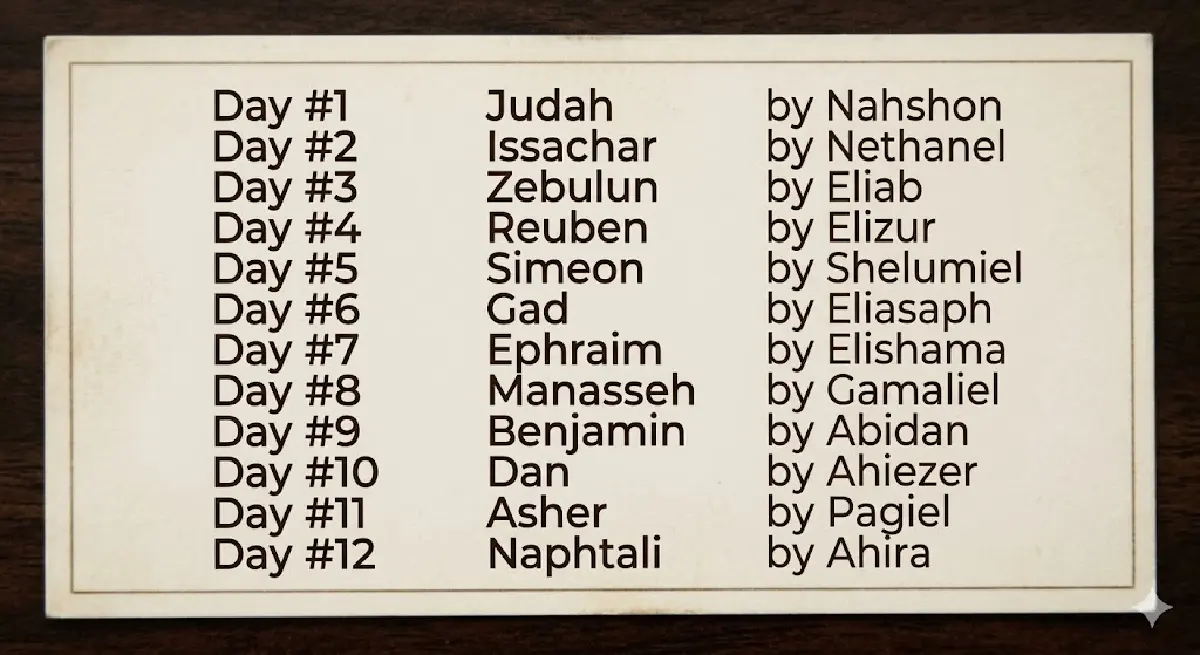
Each day, a leader from one tribe would offer an identical gift (Num 7:10-11). Everyone needed to be represented. The chapter’s length is due to listing what each leader brought, even though the offerings were the same. The twelve designated leaders, one from each tribe, made these offerings on their appointed day. There is no specific explanation for these offerings. They symbolize cleansing from sin, purification, ongoing commitment, and dedication in the altar’s consecration.
- Day #1 Judah by Nahshon
- Day #2 Issachar by Nethanel
- Day #3 Zebulun by Eliab
- Day #4 Reuben by Elizur
- Day #5 Simeon by Shelumiel
- Day #6 Gad by Eliasaph
- Day #7 Ephraim by Elishama
- Day #8 Manasseh by Gamaliel
- Day #9 Benjamin by Abidan
- Day #10 Dan by Ahiezer
- Day #11 Asher by Pagiel
- Day #12 Naphtali by Ahira
Grain offering (Num 7:19)
- 1 silver dish (130 shekels) – full of fine flour mixed with oil
- 1 silver bowl (70 shekels) – full of fine flour mixed with oil
Burnt offering (Num 7:20-21)
- 1 gold pan (10 shekels) full of incense
- 1 bull
- 1 ram
- 1 yearling male lamb
Sin offering: (Num 7:22)
- 1 male goat
Peace offering (Num 7:23)
- 2 oxen
- 5 rams
- 5 male goats
- 5 yearling male lambs
2. Purpose Of The Offerings (Nu 7:3-9, 10-11,84-88)
We shouldn’t disconnect the free will offerings from their purpose. Part of their value lies in what they contribute to God’s plans.
1. The Carts and Bulls
The leaders recognized a significant need. It may have first been expressed in a complaint. We know they were sensitive to the needs of the Levites, who didn’t have vehicles. These vehicles clearly showed that the people of Israel were traveling toward the Promised Land. Their current home was not their permanent residence.
It’s less like our need for a vehicle to get around (since people always need to travel) and more like a missionary needing a vehicle to spread God’s Word. This is directly connected to kingdom work.
2. The Dedication of the Altar
This freewill offering consisted of four different contributions.
The grain offering: our contribution to God’s work and ongoing support. The burnt offering: our dedication and commitment to God’s purpose. The sin offering: our confession of sin with hope for forgiveness and atonement. The peace offering: our desire and understanding that our relationship with God is vital. The people initiated these offerings to establish their connection and relationship with the Lord. Perhaps they still carried guilt from worshiping the golden calves. These four offerings demonstrated that it was not just a contribution but an expression of attachment to Yahweh, their covenant God. How much do I value this dedicated relationship and commitment to the Lord?
Verses 84-88 summarize these offerings by articulating their total numbers. “This was the dedication offering for the altar after it was anointed” (Num 7:88).
It’s crucial for us to remember what Jesus has done for us. These sacrifices on the altar wouldn’t have an atoning effect if Christ the Messiah hadn’t come later. Neither would any of us have the way to approach God’s holy presence without Christ’s death on the cross. Jesus is the Way, the Truth, and the Life (John 14:6).
“23 For all have sinned and fall short of the glory of God, 24 being justified as a gift by His grace through the redemption which is in Christ Jesus, 25 whom God displayed publicly as a propitiation in His blood through faith” (Rom 3:23-25).
Application
By possessing the New Testament, we know and can treasure God’s gift of Christ for us on the cross, cleansing us from sin. Jesus Himself tends to the altar by laying Himself on it. Afterward, as High Priest, He continually intercedes for His people (Heb 2:17). All of this demonstrates His amazing grace “for all have sinned and fall short of the glory of God.”
3. Distribution Of Gifts (Nu 7:6-9, 84)
1) The gifts of the horses and carts were given in a total of twelve. This number has many factors and could have been divided equally either by the number itself or according to Levi’s three sons. Neither method was chosen. Instead, the Merarites, who had the fewest people and were later-born, received 75% of the oxen and carts. The Gershonites received the remaining 25%. The Kohathites, the most responsible group, received none. The tribes presented this gift to meet the traveling needs for the journey to the Promised Land. Since they had to carry the sanctuary, the goal was to lighten the load for the priests. The Merarites carried the basic structure and needed the most help. The Gershonites handled decorative items like curtains that hung over the boards. The Kohathites received no assistance because the objects were too holy to be moved by carts; they were to be carried by the priests alone.
2) The dedicatory gifts for the altar were given for its specific purpose, likely to represent the tribe at the sanctuary. Each tribe wanted to be remembered by the Lord. They offered honorable gifts, which the Lord accepted as well. The meats, no doubt, were divided according to a predetermined plan. The priests ate certain meats that were offered to the Lord.
The Lord values freewill gifts. His people can use them, but stay open to how He might guide their use, even if it differs from our own ideas. Make the gift a reflection of our joy in giving to the Lord first. Second, let it be a response to a need you observe. And finally, do not expect it to be used in a certain way. [Don’t abuse the giver’s intention!]
4. Worship at the Tabernacle (Numbers 7:89)
After these offerings, Moses entered the tabernacle (i.e., the tent of meeting). There he met with Yahweh and heard “the voice” speaking from above the mercy seat on the ark of testimony.
“Now when Moses entered the tent of meeting to speak with Him, he heard the voice speaking to him from above the atoning cover that was on the ark of the testimony, from between the two cherubim; so He spoke to him” (Num 7:89).
In the New Testament, we find all the saints raising their voices to God for His wonderful grace, gaining a secure welcome to come into His presence.
“After these things I looked, and behold, a great multitude which no one could count, from every nation and all the tribes, peoples, and languages, standing before the throne and before the Lamb, clothed in white robes, and palm branches were in their hands; 10 and they cried out with a loud voice, saying,
“Salvation belongs to our God who sits on the throne, and to the Lamb” (Rev 7:9-10).
Some consider this text a later addition to the original because it lacks sufficient context. However, by starting at the beginning of this chapter, in verse 1, we can clearly see the setting. This was the day Moses finished setting up the tabernacle and consecrated it along with everything inside. What made this day especially significant was the voluntary gifts and support from all the tribes for the priesthood, which was responsible for caring for the tabernacle. This entire system is impressive in itself. Only through the Lord’s explicit command could an entire tribe agree to care for the holy objects. This happened within just one year of leaving Egypt. God truly was leading the people, and the people were following Him.
Now we see the Lord taking action. Previously, He always stood outside the camp, but now He would display His glory right in the center of the Israelites’ camp. God’s presence made a difference. The altar and priests allowed God to be near the people, but in very limited ways. God spoke to Moses, and His Voice came from the throne—the mercy seat with cherubim on each side. God recognized the gifts the people offered, yet, through His very presence and spoken word, He expected them to listen and obey. We can never take God’s presence or voice for granted.
His Word is vitally precious to us, and His presence is our salvation. Nor can we assume God will reveal Himself fully without some cost. As we draw closer to God, He draws closer to us. The manifestation of His glory assumes His shared holiness. That is why repentance brings such rich blessings. Even our gifts are subject to His approval—He decides whether they are acceptable. Let’s remember His glory and grace and regularly come before Him, “continually offer up a sacrifice of praise to God, that is, the fruit of lips that give thanks to His name” (He 13:15).
Application
Gratefulness should fill our hearts for Christ’s work for us on the cross that enables us to come into God’s presence. Live holy lives and enjoy the abiding presence of God. Do not despise the privilege but delight in His holy presence.
“Behold, I stand at the door and knock; if anyone hears My voice and opens the door, I will come in to him and will dine with him, and he with Me” (Rev 3:20).
Discussion Questions on Numbers 7
- Review Number 7 and identify the two sets of offerings that occurred.
- Differentiate between the temple and the altar. What was each used for?
- State what was included in the dedication of the tabernacle.
- State the four types of offerings made during the altar dedication.
- What do you think the purpose of the sin offering was? How did Jesus assist us with our sins?
- What do you note about God and Moses from verse 89?
- Why do you think God was okay with using a tent as His meeting place?
- Were the Israelites forgiven of their sins even when God does not consider animal sacrifices sufficient (cf. Heb 9:12-14)?
- Read Hebrews 13:12-16. How should the wonderful sacrifice of Christ lead us to approach God’s presence?
Other Related Articles by Paul J. Bucknell
Numbers Introduction and Overview | The Bible Teaching Commentary
.....The Introduction and summary for the Book of Numbers, Numbers 1-36 with diagram and chart giving an overview.
Numbers Outline - Preparing for the Lord’s Battle | The Bible ...
.....The outline for the Book of Numbers 1-36.
The Pride of the Self-righteous (Numbers 20:11-12) | Biblical ...
.....Striking Twice (Numbers 20:11-12). Why did God judge Moses so strongly? Instead of speaking to the rock, Moses struck the rock twice. Because ...
An Overcoming Spirit- Numbers 13-14 - Slide #10_3
.....God decided they were not ready to go.Numbers 13: 28-14:1 28. Nevertheless, the people who live in the land are strong, and the cities …