Written by Paul J Bucknell on June, 04, 2026
Proverbs 29:25 - Conquer the Fear of Man
Few are trained to see how people manipulate others through fear. Individuals and groups use their authority to intimidate and control by exploiting fear. Honestly, we face many frightening situations: environmental hazards, health threats, financial insecurity, and even threats to life itself. But the truth—rooted in the fear of man—runs deep and can help us navigate a darker valley more smoothly.
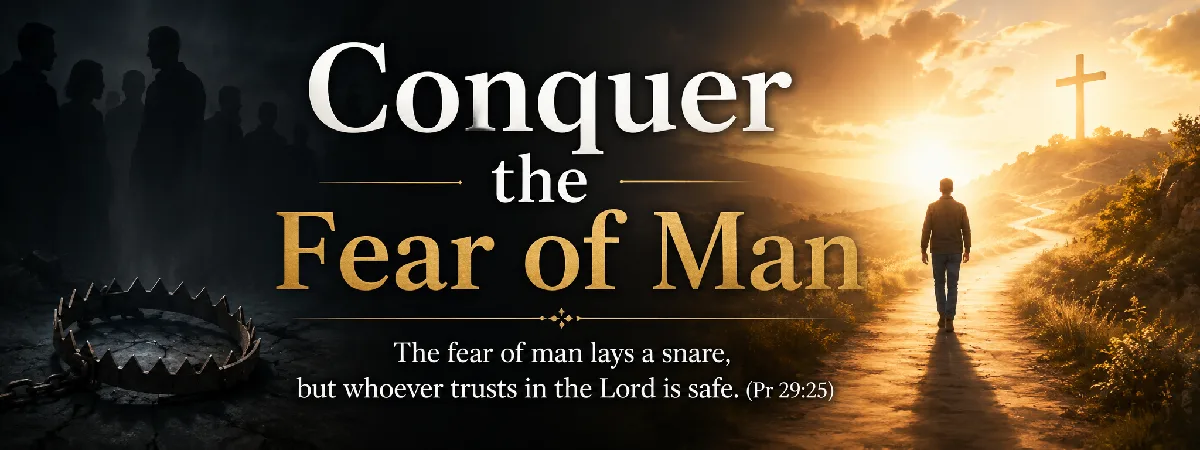
The fear of man lays a snare, but whoever trusts in the Lord is safe. (Pr 29:25)
People are driven by fear or lust (such as for money). Society declines each time a person slips further into compromise. Verse 25 points to a way we can safely overcome this fear of man. It’s like the growing fear that arises when you’re lost in a dark forest, until you meet someone you know. They are willing to guide you to safety. The Lord Yahweh is the one we need to turn to. He always seeks to be that friend to lead us out. First, let us better understand the dynamics behind fear and compromise, and then discuss how we can trust Him to protect us
1. The Fear of Man
The fear of man lays a snare, but whoever trusts in the Lord is safe. (Pr 29:25)
We need to first understand what the Bible verse in Proverbs is trying to communicate and how it accomplishes that.
The Lord shows how people use fear to control others. We might think of a bully. As we grow older, we realize that he represents the evil desire to dominate others for personal gain. On a larger scale, people develop tactics to scare others into making the choices they want. They manipulate others through fear. Of course, it could be based solely on fear, if unfounded, as long as it is perceived as real, which can trap people. Still, we will focus on the more common situation where people try to control us.
Once the fear or threat is accepted as real, people become vulnerable. Verse 25 describes this as a snare or trap. Before falling in, a person is free; once he falls in, he becomes trapped. So how does this work?
When people feel threatened, fear emerges, prompting them to react. The first part of the verse shows how many accept the fear and the suggested or imagined consequences as enough to meet the person’s expectations. Perhaps fearing job loss, they become willing to make false entries in the company’s financial records, as their boss demands. Parents sometimes use the threat of abandonment to get their children to obey. A boyfriend might hint at leaving a girl if she doesn’t comply with his wishes.
People often quickly follow what others desire when fear influences them. They seek control over a person or group, whether it’s over money, sex, or simply to earn your admiration. Fear occurs when we worry about losing something beyond our control, such as a person: a job, a relationship, acceptance, or even life itself.
The snare refers to the difficulty of getting out of the circumstances once a person steps into the trap. They are caught. The best thing is to never fall in, and so this Proverb helps protect and keep our souls safe.
The fear of man encompasses various threats people make against us. Sometimes we know the people, but more often, with the internet, we hear and feel their hidden threats. We should add to this all the hype on social media, because people are trying to ensnare others to get them to buy this, sell that, move here, do that, and so on. Some of this fear is driven by organizations or governments pushing their agenda on their own people, perhaps to secure their vote, shift their money, or influence other decisions. Authorities now admit that the intimidation to take the vaccine for the C-virus was wrongly handled. People feared a serious disease and were willing to follow the advice given, even though it was not proven.
Fear is used as a tool to control others. Study and research reveal these theories and their applications to fear-appeal, moral panic, and securitization. They are especially effective when a solution is provided. Social media would seem to have given us different opinions, but most often, people listen to those they agree with. People behind these movements seek to “ensnare” us with their offered solutions.
Proverbs 29:25 identifies the vulnerability of humans to fear and its consequences, but only to help point us to the solution, namely, to trust in Yahweh’s care for us, His people.

2. Our Trust in God
The writer, perhaps King Solomon, has great confidence in the remedy offered: “But whoever trusts in the LORD is safe.” He explains what action to take: “Trust in Yahweh,” as well as the outcome: “is safe.” It’s a promise of how our covenant God will watch over and protect us, His people.
The word ‘promise’ in the Book of Proverbs is used differently from its usual Biblical meaning. However, by observing repeated actions, we see that these actions produce their corresponding results. Warnings and statements like “Whoever trusts in the Lord is safe” are like that. Does it mean that there will be no exceptions? Not really, because harm can happen, as it did to Jesus on the cross or to many martyrs today. However, the truth remains: those righteous people who trust in God are always safe. Jesus trusted in God His Father, and God delivered Him from death to resurrection and crown. The statement is not a literal promise of complete physical safety, but rather a promise of long-term well-being. We can trust God and His goodwill for us when we trust in Him. Always.
From the Bible, we see this is not just the writer’s observation but the absolute truth, found throughout the Scriptures. “And those who know Your name will put their trust in You, for You, O Lord, have not forsaken those who seek You” (Psalm 9:10).
Faith in Fear’s Cries
In either case, one must act with faith in God’s words rather than one’s fears, which are triggered by what one thinks, believes, and perhaps by exaggerated visions of the imagination. A person becomes convinced they need to protect their security. A doctor or assistant, for example, might be expected to help with ‘degendering’ a young teen, an operation to transform a male into a female (which cannot be done). Filled with anxiety, the doctor tries to avoid the task, but the authorities infer unwelcome scenarios, such as the loss of his contract. Additional fear grows as bills mount. Once someone complies, they become trapped, and their past actions determine their fate, though God always provides a way out.
Faith in God’s Word
Faith is also used to trust in the Lord. As you trust (lit. have faith) in what He says, you will be safe. Giving in to fear doesn’t bring peace because it implies immoral compromise, putting one at odds with the Lord. God provides an alternative. He can and will bring us to safety. Jesus’ name means “Savior”; He specializes in helping people who trust in Him. The Exodus magnificently displays this, such as when God made a path through the Red Sea.
Instead of responding with fear to those who try to intimidate us, we can trust in the God who created and sustains us. By trusting Him with our safety, we can rely on Him to care for us—no matter how He chooses to do it. Take a moment to carefully read the following verses from Psalm 91.
2 I will say to the Lord, “My refuge and my fortress,
My God, in whom I trust!”
3 For it is He who delivers you from the snare of the trapper
And from the deadly pestilence.
4 He will cover you with His pinions,
And under His wings you may seek refuge;
His faithfulness is a shield and bulwark.
5 You will not be afraid of the terror by night,
Or of the arrow that flies by day;
6 Of the pestilence that stalks in darkness,
Or of the destruction that lays waste at noon.
7 A thousand may fall at your side
And ten thousand at your right hand,
But it shall not approach you. (Psalm 91:2-7)
Not all the dangers mentioned above are from the fear of man: pestilence, flying arrows, death plagues, and fearsome darkness, but many are. Those threatening his life all point to the fears the Psalmist was very aware of. He identified the fears associated with their threats and actual arrows. In other words, it’s okay to pay attention to how these situations can threaten our lives. Fear does have its positive aspects, causing us to minimize trouble by taking certain precautions.
But the Psalmist did not stop there. His list was long, but the power of trusting in the Lord triumphed over all the most feared situations. This is something like Romans 8:35, where he lists off so many dreaded moments: “Who will separate us from the love of Christ? Will tribulation, or distress, or persecution, or famine, or nakedness, or peril, or sword?”
The fear of man will paralyze our responses, narrowing our choices to what the fear-inducer wants. We don’t need to know how things will work out, but only that fear’s path is not one that God wants me to take. Once the immediate temptation is resisted, we can contemplate God’s better way; the fears dwindle.
Let me give you some practical advice if fear has already taken hold of you. That means you’re in a situation that’s hard to escape, at least on your own. This verse, however, highlights the power of faith. You will face more challenges when resisting those trying to intimidate you, but at the same time, you need to be clear and trust the Lord.
Here are a few other translations of Proverbs 29:25.
- He that feareth man, shall quickly fall: he that trusteth in the Lord, shall be set on high. (DRA)
- The fear of people becomes a snare, but whoever trusts in the Lord will be set on high. (NET)
“The image of being set on high comes from the military experience of finding a defensible position, a place of safety and security, such as a high wall or a mountain. Trusting in the Lord sets people free and gives them a sense of safety and security (e.g., Prov 10:27; 12:2).” [NetBible footnote #82 for this verse.]
The image of finding a protected place, such as a high wall or a mountain, instills much confidence. The Lord wants us to trust Him for deliverance and protection.
Processing Our Fears Into Faith in God
Begin by acknowledging the fears that arise when you think about the consequences of your situation, but never stay there. Always bring the Lord Yahweh into your thoughts, even if it means a desperate cry of “Save me.” While extreme cries are not always needed, they can sometimes be helpful. In our prayers, whether we’ve lost our jobs or don’t have enough money for rent, include the Lord in our prayers. Let me give you a sample prayer.
Lord, I might lose my job if I don’t do what the boss wants. I don’t know what I would do without my job, but I also cannot take the action my boss demands. I sense the enemy wants me to panic and give in, but I’m going to step back a bit and entrust my situation to your hands. You are my God and Savior. I worship You and bow down to no other. You don’t just care for my spiritual life but my life overall. I’m not sure how this will end, but I will watch how you will take care of me. I’ve come to the end of what I can do. I cannot do what he says and will kindly tell him, but I need you to lead me. I’m waiting for you! In Jesus’ mighty Name I pray, Amen.
Do you see how, at first, you are forced to focus on the circumstances, but then bring the Lord in? As you do, your faith in Him grows, as seen in a growing assurance of His care for you and in your ability to speak about how He will somehow help you. This highlights both your trust and His way of securing you, though not sure what it looks like. Surely, we don’t know where it might lead. We can tell Him that, but ask that He hold our hands to guide us out of that dark forest. You can go through the major options and trust Him for each, but let Him work it out. If He brings ideas to your mind during this time, pay close attention to them, especially if they are consistent with God’s Word. Discuss this with more experienced people, such as your parents or a pastor, or take specially led actions, such as fasting.
If worries occupy your mind, try writing them down or speaking your prayer aloud. Make sure that if the Lord points out some sins in your life during prayer, you confess them right away. After you’ve confessed any worries or fears you already have, pay attention to whether He offers any suggestions. Be mindful of those the Lord brings to mind around you. God, the Sovereign One, controls all circumstances, but He also speaks softly at times.
Conclusion
The Lord doesn’t just want to deliver us; He desires us to trust Him during unexpected, challenging circumstances. He aims to make Himself known and magnified.
Proverbs 29:25 Study Questions
- What fears lurk nearby you? Do any of them fit into the category of ‘fear of man’?
- What does Proverbs 29:25 say will happen if you accept the fear of man? Do you have an example of when you did this?
- Have you ever noticed how the Lord intervenes in your everyday life?
- What does it mean to include the Lord in your prayers?
- Practice the above action now by describing a situation in which someone, or a group, tries to control you through threats. Invite the Lord into this situation during your prayer and share your experience.